Travel, mishap, and adventure in a beautiful and bizarre world.

Sunday, 18 January 2015

One of the World's Highest Bridges: Miallu Viaduct

I know, I know. Another stupid bridge. Yes, I want you to go see a bridge. Actually, this bridge is pretty awesome. And besides the bridge itself, there are lots of other great things to see around this area, including the town of Miallu and the Tarn Gorges. This is the Miallu Viaduct.

First of all, let's clear up the pronunciation difficulties. It is not MEE-ow Viaduct. It is not The Viaduct of Cats. It's also not the mee-AH-loo Viaduct. If you tell your friends in the French town of Servian that you are going to visit the mee-AH-loo Viaduct, they will just look at you quizzically and wonder where you learned your (bad) French. Trust me, I've done that before. Pronounce it: mey-AU.
Okay. With that out of the way...
The Miallu Viaduct is a 394,000,000-Euro bridge that spans the valley of the River Tarn in southern France. It was built so people living on one side of the valley could get to work in places like Clermont-Ferrand (on the other side) more quickly. It bypasses Miallu completely, so why it's called the Miallu Viaduct I have no idea. Before the bridge was constructed, everyone had to drive into the valley and back up the other side, causing traffic jams in the middle. (It must have been a really annoying problem if they spent almost 400 million euros on it.)
You won't get this cool a view... unless you take a helicopter. Photo credits to www.wikipedia.org
 Anyway, this bridge is a fabulous architectural wonder. If you're less than a couple hours away from it, I would highly recommend going there. But the question I'm answering is "Is it better to to view the views from on top of the Miallu Viaduct, or drive into the valley and see the viaduct, but not be able to look down into the valley?"
The answer is surprising, but not once you've driven over the viaduct.

First, let's define where the Viaduct actually is. The nearest large city is Montpellier, which it is about an hour drive north of. I could say it's in the centre of southern France, if that helps.
*note* There is currently construction about 20 minutes from the viaduct on the A75.

My Experience
The awesome view of the viaduct in the bottom of
the Miallu Valley.
When I visited the Miallu Viaduct with my family, we incorporated it into a day trip with a visit to the Tarn gorges and the nearby towns. Coming from the south, we drove along the E11 and turned off at the visitor centre to hang out and get some cool posters. After that, we drove into the valley on the D41A (this will make more sense when you see the map) and were able to get some good views of the viaduct. There's a really nice viewpoint right at the bottom of the valley where you can pull over and get out of your car, looking up at the bridge. After that, we drove back up the other side, on the D41. We passed Miallu and followed the D809 along the banks of the river. There are several nice towns along here; Aguessac, Compeyre, La Cresse, Rivière-sur-Tarn, Le Rozier, Les Vignes, and others. (By the way, if you stop in Les Vignes, there's a restaurant with a beautiful view over the river... just don't order the chèvre salad.) After having lunch in Les Vignes, we drove around the Tarn Gorges. There are several great viewpoints, and if you can stomach the bumpy road, there's much beauty to be discovered in this region of France. On the way back, we got out of Miallu via the D911 instead of the D41. This road took us a few minutes north until we found a complicated traffic circle that got us onto the A75, going south. (It's hard to find other roads that get you onto this highway, most of them go under the viaduct.) This is where we went through the toll booth and got onto the viaduct.
Here's a map of the Miallu area. NOTE: Highways D992 and the E11 (aka big orange line) do not intersect
(the D992 goes under the viaduct). Also, the D911 and E11 meet up farther north.  

MY AMAZING JOURNEY ACROSS THE VIADUCT...
Was surprisingly dumb. Well, no. It felt cool, but all you can see are the 3m- tall plastic barriers and the huge suspension lines as you pass under them. Had I not known that the viaduct existed, I would have been thinking, "oh hey why'd they stick these stupid poles here on this random stretch of highway...?" The change is almost unnoticeable.

So to answer your question... By all means, driving into the valley is the best way to see the viaduct.  It also gives you a great opportunity to discover the Tarn Gorges, instead of just driving over the viaduct, past the town of Miallu, then turning around and going back. Actually, don't even bother with the bridge unless you have to. However, if you are planning a trip to the South of France, you might want to keep reading for some more tips about how to spend your day at the viaduct.
If you turn around and look out the back of the car window
after crossing the viaduct, this is what you'll see.

My Advice
1a) If you are staying close to the Miallu Viaduct: Devote one day just to exploring the valley and the viaduct, and come back for a more thorough trip around the Tarn Gorges.
1b) If you aren't staying close to the Miallu Viaduct: Get up early, and spend the day exploring the viaduct, the Tarn Gorges, and the surrounding towns and villages.
2) Going into the valley is essential, going over the bridge is not. It's fascinating to go into the valley where you'll be able to really appreciate the huge viaduct. If you're in a rush to get back to the town you're staying in and want to say you've been on the bridge, you can go over, but there will be nothing to see except at the very end after you've crossed the viaduct (see picture at left).
3) Make sure you go to the visitor centre (if you want to buy that overpriced plastic Miallu Viaduct placemat on your wish list!). Actually, most of the things in the visitor centre are really nice, and you can look at models of the viaduct and watch a short movie about how it was built. It's a great learning experience, a lookout gives you great views of the viaduct, and most importantly... there are bathrooms.
Drive up one side of the Tarn Gorges for this spectacular view. 
4) Visit the towns! In France, it's not enough to be a tourist; you have to immerse yourself in the French lifestyle and culture. Go for a swim in the Tarn Gorges, eat at a restaurant beside the river, go on a hike, and talk with the locals (we got an awesome beach ball from a restaurant owner in Les Vignes). Don't just go to the Miallu area to see a big bridge, you have to enjoy it.
5) Don't stress over food. Bring breakfast in the car, and when you get to the Tarn gorges, park your car where there's a nice view and eat your squassionts (squashed croissants, a reference to my time in Paris). It gets very hot in the summer, so bring along LOTS of water. For lunch, eat at one of the local towns along the gorges. For dinner, buy a baguette (or whatever) from a café and eat it in the car.

Well, I hope this helps you if you ever find yourself in the south of France with a day to spare. And if it wasn't useful at all and you're never going to go see the viaduct, well, you just read three pages of me ranting about overpriced placemats in the visitor centre. Which is okay, too.

Friday, 2 January 2015

Transportation Around Paris

By this point, you've probably read several posts about the various attractions in Paris, France. However, you need to know the various options available for travelling around the city, and
this post will list their convenience, cost, and fun-ness.

#1: Walking:      Cost: None      Convenience: 3/5        Fun? Depends where you are in the city
Pros- Walking is great exercise, and there's way more to see travelling on foot than underground in a Metro station. It's very inexpensive (you just have to eat more food/fuel!) and you can be mentally lazy and not have to worry about which stop to get off at. Some areas of Paris are better than others, of course, but walking is a great way to really appreciate the city.
Cons- It's sloooow. And if you're in Paris during a rainstorm (which isn't exactly uncommon), you're not going to have much fun in the forty-five minutes it takes you to get from the Louvre to the Luxembourg Gardens. So it's easy, but not always convenient or fast due to weather issues. And you also have to not trip over any natural wildlife (aka pigeons).

#2: Metro      Cost: 1,70 Euro      Convenience: 5/5   Fun? The first time, at least.
This is a typical Paris Metro train.  
Pros- It's probably the most efficient way to get yourself around Paris, certainly for the price. The trains are always on time, and you can save money by paying about 13,70 Euros for a 10-pack, which I recommend. The ticket is effective until you leave the Metro, so you could ride around underground for a whole day and only pay 1,70 Euros. It's also super fun to take the Metro into Paris, because you're underground coming into the city and suddenly pop up right amongst the amazing architecture, just blocks away from some national landmark. You don't have to walk far to find a station, because they're almost everywhere in central Paris.
Cons- Not super interesting once you've been riding it for an hour, so try to incorporate Metro-ing with walking around the city, since all you're seeing is the inside of a tunnel. You don't really get much exercise (except for climbing the stairs...) But overall, it's definitely the most convenient form of transportation in Paris.
TIP: If you've seen the sights of Paris, this is a fun way to discover even more. Walk to a random Metro station. Pick a line and roll a pair of dice to see how many stations you go before getting off. Explore that area, then walk to a different station and choose a different line to go on. Take it in the opposite direction. Go aboveground and explore. Repeat.

*scroll down for Metro Map*


#3: RER      Cost: Can vary      Convenience: 4.5/5      Fun? Sorta
At the Gare du Lyon, you can take SNCF trains or the TJV
outside of the city as well as change RER or Metro trains. 
Pros- This is a sort of suburban line that goes further outside the city, although it has several stops in central Paris and in some cases may be more convenient (it is faster and has fewer stops than the Metro lines). You can use a Metro ticket on these, but only in the central part of the city. If you are travelling to other zones (farther out of the city) you'll need to pay more for a separate RER ticket. If you're coming to Paris from the CDG or Orly airport, you'll take the RER into Paris.
Cons- Just like the Metro, it's only aboveground in the suburbs of Paris, and just when it gets interesting the RER trains go underground. You're better off to use the Metro system in central Paris, because it'll be easier to find a stop. Tickets can be a little on the expensive side if you're outside of the city centre. You also don't get much exercise on the RER (although you could run up and down the train if you wanted to).

As you can see, the Paris Metro/RER system is very complex...
#4: Bus      Cost: 2 Euro        Convenience: 3.5/5      Fun? Until there's the inevitable traffic jam
Pros- For short rides, travelling aboveground is definitely more entertaining, and you can also familiarize yourself with the city if you look around. You can use Metro tickets for the bus, but you can't transfer from a Metro to a bus using the same ticket. Packs of ten are available for 13,30 Euros. I'd recommend it if you're going to be on the bus a lot.
             Two-digit numbers mark Paris city buses, 
             three-digit numbers mark suburban buses.
Cons- You need to get another ticket every 90 minutes, which can be annoying if you're riding for a long time. Traffic jams can help you learn the French curse words pretty quickly (just listen to everyone when you get stuck in the middle of the city). They're slower than the Metro, although useful during bad weather.
Bus Lines Outside Paris: The Roissybus runs from the CDG airport to central Paris, but I do not recommend it. You get no view, and it's really frustrating when there's a traffic jam. It takes about an hour and a half to get to Paris from the airport, and I'd recommend going on the RER instead. (Tickets from CDG to Paris cost 10 Euros per person...Mon dieu!)


#5: Taxi      Cost: A lot       Convenience: 4.5/5      Fun? Not when you see the price meter
One of the taxi stations along the Champs-Elysées
Pros- The Parisian taxis are safe and reliable, and you can catch a taxi by hailing one on the street or going to a street corner taxi station where they queue. Available taxis have a long white light on the roof. There are over 15,000 taxis in Paris, so finding one is usually not a problem. They are certainly very convenient, and if you're tired and don't want to memorize the Metro map, are a good idea.
Cons- However, taxis in Paris are super expensive because of the traffic, and unless you have to get somewhere urgently or are very tired, I wouldn't pay the extravagant taxi fees. I would not call for a taxi, because they charge for the distance travelled to pick you up. (I learned this the hard way...) Use the Metro/RER/Bus unless you want to treat yourself.

#6: Driving   Cost: n/a      Convenience: 1/5      Fun? If you're driving it's not fun...
Traffic jams aren't exactly uncommon in Paris...
Okay. DO NOT DRIVE YOUR CAR IN CENTRAL PARIS. The parking is impossible, driving can be a terror in the city, and if you want to park on the street it costs 2 Euro an hour and you're limited to two hours. Underground lots are even more expensive. Car rentals are expensive and it's going to take you forever to get where you need to go, because there are so many cars in central Paris. If you do bring your car (which you shouldn't have), park it outside the city and forget about it. Take the Metro, bus, or ANYTHING else but DO. NOT. DRIVE. A. CAR. IN. PARIS.

#7: Biking    Cost: Varies    Convenience: 3.5/5     Fun? YES!
One of the Vélib bike stations in Paris.
Pros- The city of Paris operates the Vélib bicycle rental program using three-speed bikes which you can pick up at stations or "service points" scattered around the city. You can pick up a bike at any Vélib station and turn it in at any other. The prices are affordable (1,70 Euro per day, and 1-4 Euros per half hour depending on how long the trip is). You need to get an account and money will be taken out if you damage the bike or return it overtime. You have to be 14 or older to use a bike. These are great exercise, and are faster than walking.
Cons- Although a great way to see the city, the bikes aren't super fast. Use them mainly for cruising around, because they won't get you across the city very quickly compared to the Metro. You do need a credit card with a microchip to use the bikes, but this is not usually a problem for us Canadians.


#8: Ferries    Cost: 15 Euro/day   Convenience: 3/5    Fun? Definitely.
Is it a bird? Is it a plane? It's the Batobus!
Pros- Batobus is a ferry service on the river Seine that makes eight stops on a circular route in the central city: The Eiffel Tower, the Musée D'Orsay, Saint Germain des Prés, Notre Dame, the Jardin des Plantes, the Hotel de Ville, the Louvre, and the Champs-Elysées. It's a great way to see the city without memorizing bus routes, and it departs daily at 25 minutes intervals from 10:00AM to 7:00 PM. Once you buy a ticket, you can use it for the whole day regardless of how many time you get on and off.
Cons- Although fun, the Batobus only stops at locations on the river Seine, meaning you'll have
to find another transportation method to get to and from your hotel, unless it's right on the water. It also doesn't run in January, so plan accordingly (although it's unlikely you'll be in Paris at that time). I found the Batobus to be a bit touristy because it only visits the main attractions, but the views are stunning.

Here's a map of the Batobus route. It makes eight stops at major attractions along the river Seine. 

Overall, each method of transportation has its pros and cons, and you need to decide which one works for you. Remember to memorize your routes before you go somewhere, because opening a map and trying to figure out where you are will definitely make you a target for pickpockets. If you've lost you're way, downloading the Paris Metro app on your phone will make you less conspicuous, but don't let anyone see which pocket you put your phone in.

Most reliable: Taxi
Most convenient: Metro/RER
Most scenic: Ferries/Biking
Worst way you could possibly drag yourself around the city: Driving

This is just a brief summary, so I'd recommend checking THIS LINK for useful information should you actually be going to Paris. Have fun!


Other useful websites: 

Paris Metro:
http://en.wikipedia.org/wiki/Paris_Métro

Paris RER:
 http://parisbytrain.com/paris-rer/

Bus Map: http://www.ratp.fr/informer/pdf/orienter/f_plan.phpnompdf=bus_paris&loc=reseaux&fm=pdf

Vélib Website: (in French)
http://en.velib.paris.fr

Batobus Website: (in French)
http://www.batobus.com

Friday, 26 December 2014

Gardens In Paris: Tuileries & Luxembourg

You've probably heard about the two most famous gardens in Paris. Even if you get easily bored just hearing the word "flowers" (which I do!) these gardens are easy to enjoy, even if you're walking through them on your way to the next Metro station. This (rather short) post will compare the Tuileries and Luxembourg gardens, so if you're in Paris and have limited time, you can chose which one you want to go to.
TIP: I would highly not recommend giving yourself three or four hours just to see the gardens, because this isn't the kind of thing that you make a separate trip on the Metro for. I don't like it when these are listed as "attractions" because they're really just a part of the city and lifestyle. I'd recommend walking through one of the gardens on your way to a different attraction. Just naturally incorporate them into your day, instead of planning everything.

#1: The Tuileries Gardens
Location: Between the Louvre Palace and the Place de la Concorde, in the 1st Arrondissement.
Distance: 1km and about 15 minutes end-to-end if you don't stop or walk along any side paths.
Description: This garden provides a great contrast between forest-y and wide paths. The main walkway (Alée Centrale) runs straight through the middle of the garden, towards the big pond at the end. The gardens are very popular, but they're big enough that you can find your own place in its depths. Huge stone and bronze statues decorate the gardens, surrounded by colourful flowers. There are several snack stands on the main path, especially by the octagonal pool. Some are touristy and others are very nice. We liked the ice cream from Antonio's (the stand with the fat angel logo). You really need to be careful of pickpockets here, especially on the main path near the Louvre. I'd recommend staying on the other paths that are concealed deeper within the trees; there are less pickpockets.

Here's a map of the Tuileries Gardens in Paris:

#2: The Luxembourg Gardens
Location: Just south of Sorbonne University, in the 6th Arrondissement.
Distance: 750m and about 12 minutes if you walk quickly (from Rue Auguste Comte to Rue de Vaugirard).
Description: Where the Tuileries are rich and forested, these gardens are open and spread-out. When you see the Luxembourg Palace after going around (and hopefully not IN) the main pool, you'll be stunned. The Fontaine Médicis is also worth a look, and the many side paths winding around the gardens are great for exercise and very photogenic. You can find shade along the edges of this garden, and you can get to it quickly if you take the Metro to the Luxembourg station. These gardens can get crowded, but the wide paths and sprawling landscape make it easy to forget yourself and just spend a whole afternoon in the gardens. Unlike the Tuileries gardens, we had no trouble with pickpockets here. Another plus is that it's very difficult to get lost in these gardens: you don't need a map because the Luxembourg Palace and the octagonal pool can be used as reference points. Take your time in this garden, especially on sunny days when the flowers and trees are lush. There's a lot to see, and you need to slow down to really appreciate it.

Here's a map of the Luxembourg Gardens:

Well, I hope this guide has helped you to learn a little more about the two main gardens in Paris! (Even if you're not planning a vacation to Paris, check out some of the travel advice blog posts about the next time you go travelling.) Final tips about the gardens:

1) Never just go to a garden. Always incorporate it into the other attractions you are visiting.
Attractions near the Tuileries Garden include: The Louvre, Place de la Concorde, Place Vendome, Madeline, Champs-Elysees, Opera (some distance away), and Arc du Triomphe (some distance away)
Attractions near the Luxembourg Gardens include: The Pantheon, Sorbonne University,
Cluny Museum, Notre Dame Cathedral, Saint-Chappelle, and Musee Rodin (some distance away)
The Tuileries Gardens in the summer.

2) Always visit these gardens in the summer or spring, if possible. They are much more interesting when everything is lush and green. Autumn can be interesting, and winter is just boring. If you visit the gardens in the summer, bring a hat and sunscreen.

I hope you enjoyed reading this blog post! If you are going to Paris, also read the
4 Walks In Central Paris post for ideas on where to walk and how to incorporate the gardens into your daily life in the city.

And don't feed the pigeons (they are already overweight).


Wednesday, 3 December 2014

TRAVEL ADVICE- Enjoying Flight Connections

This is my first Travel Advice post, all about how to enjoy flight connections...enjoy!

First Steps: (connections 2hrs+) These are the first things you should do after you land, in order. 
1) Find Food. When you're on the plane and the flight attendants are chucking the unappetizing flight meals at your tray table, you'll wish you had found food in the airport. 
Organize your boarding pass...if you can
find it... WHERE IS MY BOARDING PASS?
2) Organize Your Bags. Your carry on bag probably got all jumbled up from you rummaging through it on the previous flight, so take some time to put everything in its proper pocket, and so on. This is also the time to charge your iDevice. As long as someone in your family is guarding your phone, you can charge it while you wait for the plane. It's surprisingly easy to forget to do this, actually, and if this is your only source of entertainment (which it shouldn't be) this is especially important. 
3a) If you're travelling East, you'll probably be pretty jet lagged by the time you reach your destination. This is a good time to think about the time difference at your destination and use it to your advantage. For instance, if you're waiting in Toronto for a flight to Paris, you'll know that Paris is 6 hours ahead of Toronto. So if it's 4pm in Toronto, you should be sleeping in France. Spend your time waiting for a connection getting used to the time difference.
Try to match your eating/sleeping
schedule to the one of the time
zone you are travelling to. 
3b) If you're travelling West, the day is going to keep going...and going... and going. You will just keep staying awake and you won't even be tired. Why? If (for example) you're travelling from Paris back to Toronto and your flight from Paris leaves at 1pm (Paris time), you'll arrive in Toronto at 8pm Paris time. But at this time, it's only 2pm in Toronto because of the time difference. So naturally, your brain is totally confused because it's still light outside when it should be night in Paris...(have I lost you yet?). Anyway, if you're not tired, you might as well have some fun with the airport games listed below. 

Airport Games: This is how to have fun in an airport if you have time to spare. 
 1) Find The Item: Each kid is assigned a travel item that you forgot to bring. Then, everyone has to run off and find their item in a store in the airport, buy it, and come back. The first person back gets the previously decided prize (candy for the plane, etc.) Set a time limit so your 8 year old doesn't go tearing across the airport and end up on the opposite side when you're plane's supposed to be boarding.
See if you can beat 12.7 seconds for the
100m escalator race.
2) Escalator/Moving WalkwayRaces: Choose an escalator or one of those high-speed moving walkways in the airport. At one end, race each other to the other side... but walk forwards while the escalator or walkway is moving backwards. My friend's siblings get really competitive with this (they even have timed heats.) Bonus points if you don't get caught by the airport security guards.

When You Get Tired: What to do when you can't afford the Air Canada Maple Leaf Lounge. 
1) Baggage Fort: Sit in a corner seat by your flight gate, and pile up your entire family's luggage on the side that isn't a wall. Grab an iPad/Pod and listen to music or watch a movie, and ignore the strange looks from other travellers. If your family travels really light, this won't work as well. 
This is a very successful luggage fort.
The person is inside.
2) Use The Hoodie: Unless I'm travelling to a hot climate, I always wear a hoodie. Hoodies are extremely versatile, and for those of us who can't afford the $30 neck pillows, I highly recommend stuffing the fuzzy fabric into the hood for a comfortable pillow. Tip: It's nearly impossible to sleep sideways in airports because the armrests are these giant metal things on each seat. Your best bet for sleeping is against a wall or sitting upright.

Short Connections: When you get off the plane and immediately have to get across the airport for a connection twenty minutes later, it's important not to be captivated by all the stores and food right by the place you entered the airport. Prioritize by:
On Air Canada flights, the back
of the Enroute Magazine has
maps of several major airports.
1) Getting off the plane and charging over to your gate first. A lot of airlines have magazines in the seat pockets with maps of the major airports; figure out where your connecting flight is and how to get there beforehand. Getting on the plane is more important than getting food right now.
2) Then, put your bags down and get something to eat. If you only have ten minutes before boarding, use common sense and don't eat at a gourmet restaurant. Just refill your water bottle and buy some candy or a granola bar. 
3) If you still have time after that, it's not a "short connection"...


Well, that concludes the first "Travel Advice" post! I hope you can have a more enjoyable flight connection next time you're travelling (or at least try and build an acceptable baggage fort) :)

Monday, 1 December 2014

New "Travel Advice" Blog Posts

Until now, I've used this blog for posting reviews and information about locations and attractions, mostly in France. However, I'd like to expand the purpose of this blog to not only specific places, but also general travel advice. This way, readers who might not be going to the places I have mentioned can still use the travel advice wherever they are going. Because of the variety in posts, I hope the blog will be open to a wider audience as well.
These will appear every few posts, and will also be shorter than normal posts. They will be based on personal experience rather than researched information. (I'm a trained professional in Getting Lost In Airports, Cities And Basically Everywhere.) The posts will cover preparation for travel, time in airports, flight connections, and everything in between. Some things might sound obvious, but you'd be surprised how difficult it can be to actually enjoy yourself in an airport.
I hope you enjoy reading the new Travel Advice posts! (The first one will be posted tomorrow.)


Monday, 24 November 2014

4 Walks in Central Paris

You've probably read about the different attractions in Paris, but what you won't know is how to get around the city to those attractions. Sure, you can take dumpy side streets to get to the Eiffel Tower or wherever, but there are much nicer routes that connect these attractions to each other. Also, there are other parts of Paris you want to avoid, especially at night (around Montmartre, Bois de Boulogne, Moulin Rouge, Barbes-Rochechouart, and Pigalle). These are some good walks to take that can connect you between attractions. When in Paris, I would plan out a route --for example, the Louvre to the Arc du Triomphe-- and then take the Metro back. This can also depend on the location of your hotel, so keep that in mind when planning walks.


1) Louvre - Tuileries Gardens - Place de la Concorde - Champs-Elysées - Arc du Triomphe

Distance: 3.3km    Walking Time: 40-50 mins  Time/Interest Rating: 2.4/3

Awesomest Moment: When you're standing at the Arc du Triomphe du Carousell and see the Egyptian Obelisk in the distance, and behind that, the Arc du Triomphe, all perfectly centred.

Brief Description: This is a great walk if you want to see the Axe Historique all at once. (The Axis is the string of historic landmarks and monuments in an almost straight line towards the northeast. If you do one walk in Paris, this is it: After you look in the Louvre, head towards the
This picture shows the perspective of the
Axe Historique.
Arc du Triomphe du Carrousel (basically a mini Arc du Triomphe). Then, relax in the Tuileries Gardens and try not to get pickpocketed by the overly affectionate pigeons. From there, charge through the Place de la Concorde, but get across the roundabout before you look at the lovely Egyptian Obelisk. Getting run over is not a good way to start your walk. Then, make your way up the Champs- Elysées. The first third or so is tree covered, but not super interesting. Consider finding a Metro station to get closer to the Arc de Triomphe if you don't want to walk the whole way. (The Champs-Elysées Clemenceau, Franklin D. Roosevelt, and George V. stations are all positioned along the Champs-Elysses. Most of the interesting stores are between the Franklin. D. Roosevelt and George V. stations, and the Champs-Elysées Clemenceau station is located 2/3 of the way down the tree covered section.) Of course, the Arc du Triomphe is breathtaking as it gradually comes into view.


2) Musée d'Orsay - Esplanade des Invalides - Tour Eiffel

Distance: 2.5km   Time: 30-40 mins   Time/Interest Rating: 2.5/3

Awesomest Moment: The moment when you get your first real glance of the Eiffel Tower, and wonder how you could have possibly missed it before... it's actually quite difficult to see until you pass Les Invalides!


Brief Description: This walk is a fun way to get to the Eiffel Tower (see the earlier blog post about it.) If you want to approach from the Champ de Mars side of the Eiffel Tower, this is a good way to incorporate it into your day. I would highly recommend going into the Musée d'Orsay, even if you're only there for an hour or two. From the Musée d'Orsay, follow the Quai Anatole France until it merges into the Quai d'Orsay. This boulevard is rather busy, but it is shaded.  Enjoy the fabulous views of the Seine river as you walk along its banks. About five minutes from Les Invalides, you'll see the
Palias Bourbon, an 18th century parliamentary mansion. You'll pass the Air France base before you see the golden dome behind the Musée d'Histoire Contemporaine. (Add a 6 minute walk if you want to get closer to Les Invalides and the museum.) If you're getting tired of walking, find the Invalides Metro station and take it to Ecole Militaire. If not, you have two choices:
1) Continue on the Quai d'Orsay, which later becomes the Quai Branly. This will take you right to the Eiffel Tower. (It is rather hard to miss...)
2) Continue on the Quai d'Orsay until you get to the Pont de l'Alma (no, not the llama bridge!) and then turn down the Avenue Rapp or the Avenue Bosquet. Both streets will take you to the
 Champ de Mars, from where you can walk to the Eiffel Tower. Avenue Bosquet will take you longer, since you'll have to walk the entire length of the Champ de Mars to get to the tower.


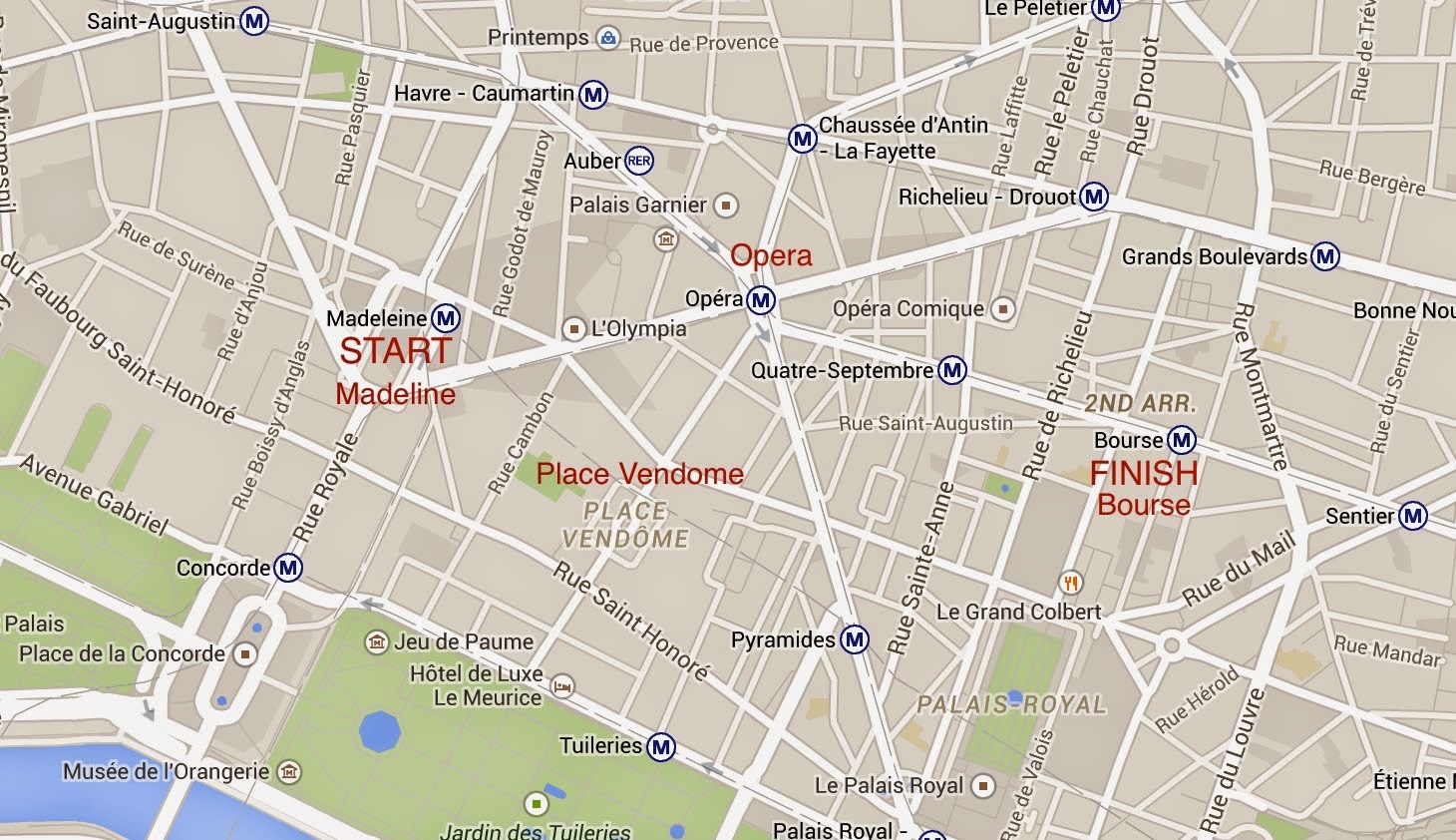
3) Madeleine - Place Vendôme - Opera - Bourse

Distance: 1.9km   Time: 20-30 mins     Time/Interest Rating: 2.7/3

Awesomest Moment: Watching the tourists go into the super expensive shops in Place Vendome, and then seeing them come out with bewildered looks on their faces: "$680 for a perfume??"


Brief Description: This is another awesome walk in central Paris. Start at the Place de Madeleine, where you'll see the BIG temple. (Of course, dedicated to the glory of Napoleon's army.)
The Place Vendôme Column from a distance...
watch out for cars!
It's startlingly similar to the Maison Carée in Nimes, only a lot larger. From there, you can walk down the Boulevard de la Madeleine, then the Rue des Capucines until you find the Place Vendôme. This is where some of the most expensive shops in Paris are. When you see a Chanel store and a Louis Vuitton store right next to each other, you know you're in an expensive shopping area. There's a big column right in the middle of the Place Vendôme, although it is currently under construction. From there, take
Rue de la Paix to the Opera, where you can marvel at the awesomeness of the Paris Opera House. (You can take a tour inside it, but I'll save that for a later blog post. After the Place de l'Opera, walk along the Rue du Quatre Septembre until you get to the Bourse Metro Station. The square is nothing special, but on Rue Vivienne (nearby) you'll notice a restaurant called Le Vaudeville. You MUST eat a meal here. It's expensive, but their smoked salmon is probably the best thing you have ever tasted. If you can't afford the (possibly) 40 euro per person cost, well... there's a Monoprix down the street *sighs*.


4) Notre Dame - Musee de Cluny - Sorbonne University - Luxembourg Gardens

Distance: 1.3km   Time: 15-25 mins    Time/Interest Rating: 2.2/3

Awesomest Moment: Just after the bridge that gets you off Ile de la Cité, you'll have the opportunity to go down the narrowest street in Paris...1.8m wide Rue de Chat Qui Pêche. It's located just off the Quai Saint-Michel.
Brief Description: If you want to see the Luxembourg Gardens and the Notre Dame Cathedral in one day, this is an excellent option if you don't want to take the Metro. (Note: If you want to do a more thorough exploration of the islands, I would not try to cram this walk into that day. Spend a whole
day exploring the islands, and tie this walk into an exploration of the area around the Luxembourg Gardens instead.) Starting at the Notre Dame Cathedral, walk across the Petit Pont, then follow the Rue du Petit Pont. It will eventually turn into the Rue Saint-Jaques, and three blocks past that point you will come across the Cluny Museum. It's full of Medieval art, located in a Gothic mansion. It's definitely not for everyone, and if you only have a few days in Paris, don't bother with it. If you're into Medieval stuff (which I'm not), you would probably find it interesting. After you pass the museum, you'll come across the Sorbonne Univeristy. Out of all the streets in this area,
In the depths of the Luxembourg Gardens, the Luxembourg Palace is...
well, not exactly hidden.
Rue des Écoles is the nicest. The others aren't spectacular or anything, but it gives you a taste of the Parisian lifestyle. As a general rule, stick to larger streets-- they are tree-covered, have large sidewalks, crosswalks, and are generally not sketchy. This is a pretty safe area, though, and you can explore any of the side streets, and... what are those trees over there? You've already arrived at the Luxembourg Gardens! These meticulously tended gardens are absolutely awesome, so enjoy a walk in the early afternoon or evening here.

I hope you enjoyed reading about these walks in Paris! If you find yourself in Paris, maybe you'll try out one of these walks. Walking to different attractions instead of taking the Metro is a great way to save money, get a taste of Parisian life, and have a good adventure!
(The most adventurous thing that can happen to you in the Metro is getting your jacket stuck in the turnstiles. Trust me, it happens...)


There's more!
Blog posts relating to these locations:
- Make the Most of Le Tour Eiffel (all about the Eiffel Tower and Champ de Mars)
- Islands on the Seine (Explains Île de la Cité, Notre Dame Cathedral, etc)
Soon to come...
- Gardens in Paris: Tuileries & Luxembourg
- The Paris Opera House

Tuesday, 11 November 2014

Canal du Midi

You probably read the post title and thought, "what the heck is this, and why are you making a blog post about it?" First of all, the Canal du Midi is a 241km long canal in the south of France. Starting near Agde (from the Etang de Thau), it winds its way across the country until it ends in Tolouse. It provides a great place for canal walks, boat rides, and watching boats travel through the canal locks. However, some parts of the canal are more industrial and less beautiful, so this post will detail where to spend your time. (Plus, some parts have trees growing on the banks and others don't. If you're planning to go to the Canal du Midi, read this post unless you want to get fried in the sun.)

There are many nice walks on the canal, but I'm going to write about the areas close to the city of Beziers. One thing you'll probably want to see are the Canal locks. (The locks used to lower or lift boats by closing gates on the canal. Not your locker lock.) These are one of the most impressive sets on the Canal du Midi, and if you’re in the Languedoc region and have some free time, I’d recommend going there.


 First of all, some interesting locks can be found near Beziers. This will become easier if you look it up on Google Maps, but regardless of which direction you’re coming from, you’ll want to get onto the Avenue de Port Notre Dame, and then turn onto the Quai du Port Notre Dame. There are many rural country roads around here that can get you to the locks, but there’s no garuntee you won’t get stranded in the beautiful French countryside. These roads are narrow and not well marked. Stick to main streets.
 If you made it to the locks, (close to Les Halles Centrales) find a parking spot along the canal and walk uphill (there are lots of stairs). The locks don't have guard-rails, so if you bring young kids, watch them closely...Being in the canal is not very fun when you don't have a boat.
The locks are opened...Don't fall in!
They have decent food here, so if you didn't bring any, get something to eat and sit on the edge of the canal. The nine canal locks are quite impressive, but become much more interesting when you see them in action...

This is a video I took of a boat waiting to travel to the next lock. 

As you can see, the locks are awesome and impressive when in use. However, if you're getting tired of watching the canal and actually want to go IN it, walk up the river until you get past the locks. There, you'll find some boat rental companies. If you don't have a boat permit, your options are a little more limited (they're not renting you a gigantic barge just so you can crash it into the banks).
When our family went here, we rented one of these small electric boats.

Pros and Cons of Renting a Small Electric Boat
Pros: 
• Relatively inexpensive (I think it was 20-25 euros per hour). Compared to other companies, this is pretty good pricing.
• These are great fun to drive, and we let my brother Stefan do a 360 with it.
• Even with Stefan over-steering the boat and crashing it into the banks, these boats are practically indestructible and you don't have to worry about messing them up.
• You don't need a boat-driving permit to use one.
• Easier to manoeuvre than giant party barges and such.
Cons:
• These boats are S-L-O-W (5 km/hr). I wouldn't recommend renting the boats for more than an hour and a half, because after a while it will get kind of boring. Make sure you bring a picnic or something else to do on the boat, and you'll have a lovely time cruising down the canal.
• Warning: This boat is not for people with low self-esteem. We got passed at least twenty times on our canal ride, and twice by people in row boats.
• Kids 10 and under will also be strapped into embarrassing puffy life jackets.

In my opinion, the pros outweigh the cons, and if you want to try this, I would recommend it. Its a beautiful, relaxing way to tour the canal.

If driving a boat isn't enough exercise for you, try a canal walk. This is a seasonal activity, and I would definitely recommend doing it in the summer. In the right places, it is beautiful, tree-covered, and a great way to kick off a morning in France. However, some spots on the canal are industrial, mainly used for boat maintenance, not shaded, and generally not fun to walk along. This map shows the tree-covered area between Béziers and Colombiers.

Getting There:
From the canal locks, head northeast on the Chemin Rural 123, then turn right onto the Rue Alain Bashung. At the roundabout, take the first exit onto the Rue de Narbonne (D609). Then, (have I lost you yet?) take the next roundabout onto the Voie Communale 13. Follow it until you get to a bridge, then park. This will make more sense if you have an actual map in front of you.
Find the trail right next to the riverbank (it's much nicer than walking along the road). Follow the trail towards Colombiers for a calm, quiet walk. Depending on how long you want to walk, you can even go past the Traverse de Colombiers, but the trees become more dispersed after that.
Sunlight on the Canal makes for great photos.
This isn't jetpacking or anything, and it's not for everyone. While some people enjoy the serenity of a morning on the Canal du Midi, others will be bored within minutes. It just depends on what you like to do. In my opinion, it's at least worth a look on a good day, even if you don't walk for an hour.
Final advice? Avoid areas without trees, winters, and days that aren't sunny and warm, and you'll be set for an enjoyable canal walk.

I hope this guide gives you some ways to enjoy your time on the Canal du Midi in the South of France, whether it's seeing the locks, a ride on a boat, or a walk along the banks. (Sorry, that was really cheesy.)

Tuesday, 4 November 2014

4 Sights Around Nimes

If you read the previous post about the Pont du Gard, you'll most likely be staying in Nimes overnight. And unless all you want to do is sit in your hotel room and try to find a Wifi signal (which you'll have trouble with), I'd recommend walking around and seeing the sights of Nimes.

If you are staying in Nimes: Lucky you! Even if you rented a car, enjoy walking around the city. Parking is difficult and most of the interesting stuff is all within walking distance unless your hotel is on the outskirts of Nimes. (If you're not staying in Nimes, consider staying in the nearby city of Uzès one night and visiting the Pont du Gard on Day One, and sights in Nimes on Day Two.)
If you aren't staying in Nimes: Taking a car to GET there is a good idea, but DO NOT try to drive around to all of these attractions or you will never find parking. Instead, drive into central Nimes and find an underground parking lot that is centrally located. It may take a while to find one, but they are near many of the main boulevards. You can also find them at the Eglise Saint-Baudile and the Centre Commercial on Rue des Halles. Taxis are expensive and buses are slow, so I would highly recommend parking for several hours, walking around, and picking up your car later. All of these attractions are relatively close to each other.

A map of Central Nimes. The numbers correspond to the attractions.
On to the interesting stuff...

#1: Nimes Amphitheatre- If you visit one place in Nimes, visit the amphitheatre. (It's also known as one of the giant Roman arenas where gladiators fought to the death for the entertainment of people...  Sounds like the Ancient Hunger Games.)
If you've heard of the Colosseum, this is similar. It's only slightly smaller and amazingly well-preserved. Opposite the Boulevard des Arènes, there's a nice park (Esplanade Charles-de-Gaulle). This is a nice spot to eat something. This is also a good time to point out that restaurants around the arena tend to be expensive and touristy. If you didn't bring food, find the Monoprix (European convenience store) on the Boulevard Amiral Courbet, just past the park.
Make sure you walk around the arena, but skip the tourist shop attached to the arena, unless you want to bring home a lot of pricey plastic keychains.
Touring the Arena: 
You've just arrived at the Ancient Hunger Games Arena.
You can take a tour inside the arena, and find out where the sweaty gladiators got sliced and where the audience watched. If you just want to see the arena and aren't into the history side of things, don't do this because it can become time consuming. Also, the inside of the arena has been completely reconstructed with metal bleachers and lights for concerts and events. For me, seeing giant trucks driving around on the arena floor kind of killed the "untouched, beautifully preserved" feeling. Personally, I wouldn't bother with the tour, but it's up to you.


 #2: Maison Carrée

The "Maison Carrée" officially translates to Square House... those clever Romans. After visiting the Nimes Amphitheatre, you probably came here. (To get here from the Amphitheatre, take the Boulevard Victor Hugo.) This Roman temple located in central Nimes, and like the arena it is very well preserved. There's lots of space around the Maison Carrée, but it gets crowded quickly. Beware of pickpockets here.
Don't walk up the steps of the Maison Careé when you're trying
 to take this dramatic photo, because you'll most likely trip and
fall, and you'll scratch your camera lens and then your brother
will bend down to help you and drop HIS camera and...
 sorry, had a flashback.
 Inside, you can watch a 20-minute film that describes what daily life is like for an inhabitant of Nimes during the Roman Empire. It's informative and quite interesting, and the 3D movie and fabulous sound system make it quite realistic. If your feet are tired and you have 5 euros burning a hole in your pocket, it's worth a try. Overall, this is a great place to sit down, relax, and enjoy some Roman architecture.
Sometimes people don't enjoy these attractions because "there's nothing to DO there" (you won't find a roller coaster at the Maison Careé), but you will enjoy it if you let yourself appreciate the monument. There's nothing like it in Canada!


#3: Eglise Saint-Baudile


The ancient, beautiful Eglise Saint-Baudile looks almost
out-of-place in the modern city of Nimes.
This cathedral is a (relatively) farther distance away from the other attractions, so I wouldn't bother with it unless your car is in the underground lot here. If possible, I would recommend parking here because it's easy to find your car-- just look for the massive cathedral and you'll find the right carpark.  It's very beautiful from the outside, with towering spires and large glass windows. Don't confuse this with the Nimes Cathedral, which is concealed in the very centre of the city. (The Nimes Cathedral is definitely less impressive than the Eglise Saint-Baudile, but there's a nice square with some good restaurants right in front of it.) It's not worth spending too much time here, but the cathedral's striking presence makes it worth a stop if you're nearby.


#4: Jardins de la Fontaine
The Jardins de la Fontaine are an excellent place for an
afternoon walk.


If you're in the mood for a relaxing walk, this is the place. Even when crowded, these gardens are wonderfully peaceful. If you didn't get enough exercise getting lost in the winding streets of Nimes, or have a little more time left before your parking pass expires, the Jardins de la Fontaine are worth a few minutes. You can take a walk along the Quai de la Fontaine, which (surprise surprise) has two fountains near the end.
The Temple of Diana is interesting and if you have 30-45 minutes, I recommend you climb to the top of the Tour de Magne at the top of the hill for spectacular views over Nimes (and a great photo op). The steep to the tower is tiring, although a great  opportunity to see the massive, sprawling gardens. There are several paths to the top; some paved, others twisting steps. Once you descend, you'll find lots more dramatic fountains all over the gardens. If you're looking for lots of flowers go in the spring or summer, when they are in full bloom.  However, the gardens are well tended and a great place for a walk and some fresh air. This is a popular attraction (for ducks as well as humans), but the gardens are quite expansive and it doesn't usually feel crowded like attractions in central Nimes. Overall, this is a peaceful haven in the middle of a bustling French city, and provides a great contrast to the narrow, shop filled streets.


If you have a day in Nimes, visit these attractions... they are not to be missed! And even if you're not going to Nimes soon, I hope you enjoyed reading!

Monday, 27 October 2014

Le Pont du Gard is Definitely Worth It


If you know your way around the south of France, you'll know about Nimes. And if you know your way around Nimes, you'll have heard of the Pont du Gard, a huge three-tiered Roman aqueduct. This massive architectural feat that crosses the river Gard is very well preserved. It's part of the Nimes Aqueduct, a 50 km-long structure built by the Romans to carry water from a spring at Uzès to the nearby city of Nimes. Okay, enough boring details. This guide will detail how to enjoy your time at this aqueduct, assuming you ever find yourself around Nimes. 
NOTE: The Pont du Gard is NOT in Nimes. As you can see from the map below, it's about a 30-minute drive from central Nimes. The next blog post will detail sights in Nimes, which you may want to coordinate with your time at the Pont du Gard. I highly recommend making the Pont du Gard a day trip, and staying in Nimes for one or two nights. 
This map shows the relationship between the Pont du Gard and the nearby city of Nimes.
Anyway, you can approach the Pont du Gard from the Right Bank (closer to Nimes) to the Left Bank (closer to Uzès). Either way, you'll probably get lost because all the trees make everything very confusing. (Warning: In the winter season, they sometimes close the access from the right bank and you can only get to it from one side due to flooding.) There are parking lots on both sides, but if you have less time for walking just visit the left side, since that's where the museum and food is.

Right Bank: Park and walk up the path towards the Pont du Gard... it's not exactly easy to miss! If you want to take panoramic photos, this is a great spot because you can find places that don't have a lot of trees on the banks. Enjoy the views of the Gard river; they can't be described in a photo. There's not a lot of shade here, so bring a hat. 

The Pont du Gard from the Right Bank path.

After a few minutes of walking, you'll notice the towering aqueduct right above you.
It's massive-- about 250m long and 49m tall.
You can walk across it on the second level on a big bridge that was later built onto the aqueduct. (If you look closely, you'll notice that the lower arch has been supported by more recently built arches, so people can walk across without worrying that it'll collapse. Just to make sure...
 As for the lower level, you wouldn't want to walk down there. The pillars that are in the river usually have huge whirlpools forming around them, and you can watch (brave) people kayaking in the gorge.


The view from the left bank, after crossing the aqueduct.
Did you notice the top level of the aqueduct, with all the tiny arches? That's where the actual water was transported. Several years ago, they actually let you go up ON TOP of the aqueduct (which is about 1m wide, with no guard-rails or anything). The ultimate adrenaline rush! I would definitely recommend not doing this if you are afraid of heights (I haven't, but my dad told me about it). It's not open to the public anymore, but it sounds pretty awesome.

Left Bank:
Once you leave the aqueduct, you can take a longer trail uphill towards a nice viewpoint. (You might also get a view of the Pont du Gard's actual aqueduct.) 
If you went up that way, climb down and take the main route is alongside the river, you might see a very old, beautiful olive tree (if it hasn't been removed). Follow the many tourists until you get to the Espaces de Decouverte, which is basically a newly built, modern building. It's a combination of museum, information booth, small movie theatre, cafe, gift shop, and more. If you're hungry, they have excellent crepes here. The movie theatre is small, but the film about the Pont du Gard is very well done. Look up the playing times on the Pont du Gard website beforehand (link way below), because they repeat the film in different languages. If you come at the wrong time of day, you might end up watching it in German or Spanish. 
If you're into history, the museum is very informative and interesting. I tend to get really bored in museums, but the dramatic lighting and setup of the museum is actually quite captivating. There's a kids room upstairs, and you can block off different parts of the Gard river to get water in the aqueduct in an interactive display. Kids 5-11 will find it interesting. 
The Pont du Gard museum explains the history and construction of this ancient monument. 

Prices:
The $32 million project of refurbishing the space around the Pont du Gard has lost a lot of money since its recent construction because going to see the aqueduct is actually free. You only have to pay to get into the main building, and fewer people than expected have done that. I would highly recommend paying for the full experience because this is a project worth supporting, and it really is worth the money. 

This is the most visited ancient monument in France, and definitely worth a stop if you happen to be in Southern France. Thanks for reading! 

(Finally, if you are going to visit the Pont du Gard, click here for their website. Check it out for warnings about closures, information about the museum, the movie theatre, and the aqueduct itself.)


Wednesday, 15 October 2014

Islands on the Seine

Ever heard of Île de la Cité? Thought not.
A lot of people are so caught up on visiting the big attractions in Paris (the Eiffel Tower, the Louvre museum, Sacre-Coeur, etc) that they don't realize that there are other parts of Paris that have just as much to offer as the popular tourist locations. Eating delicious ice cream while watching boats glide down the Seine river is usually more fun than waiting in the hot, crowded line for the Eiffel Tower. So today's blog post is going to be all about the two small islands in the middle of the Seine river. They are named Île de la Cité (the big one), and Île Saint-Louis. On Île de la Cité, one can find the Saint-Chappelle, the Notre Dame Cathedral, and LOTS of pigeons. The following is a guide about getting to and exploring the islands on the Seine.

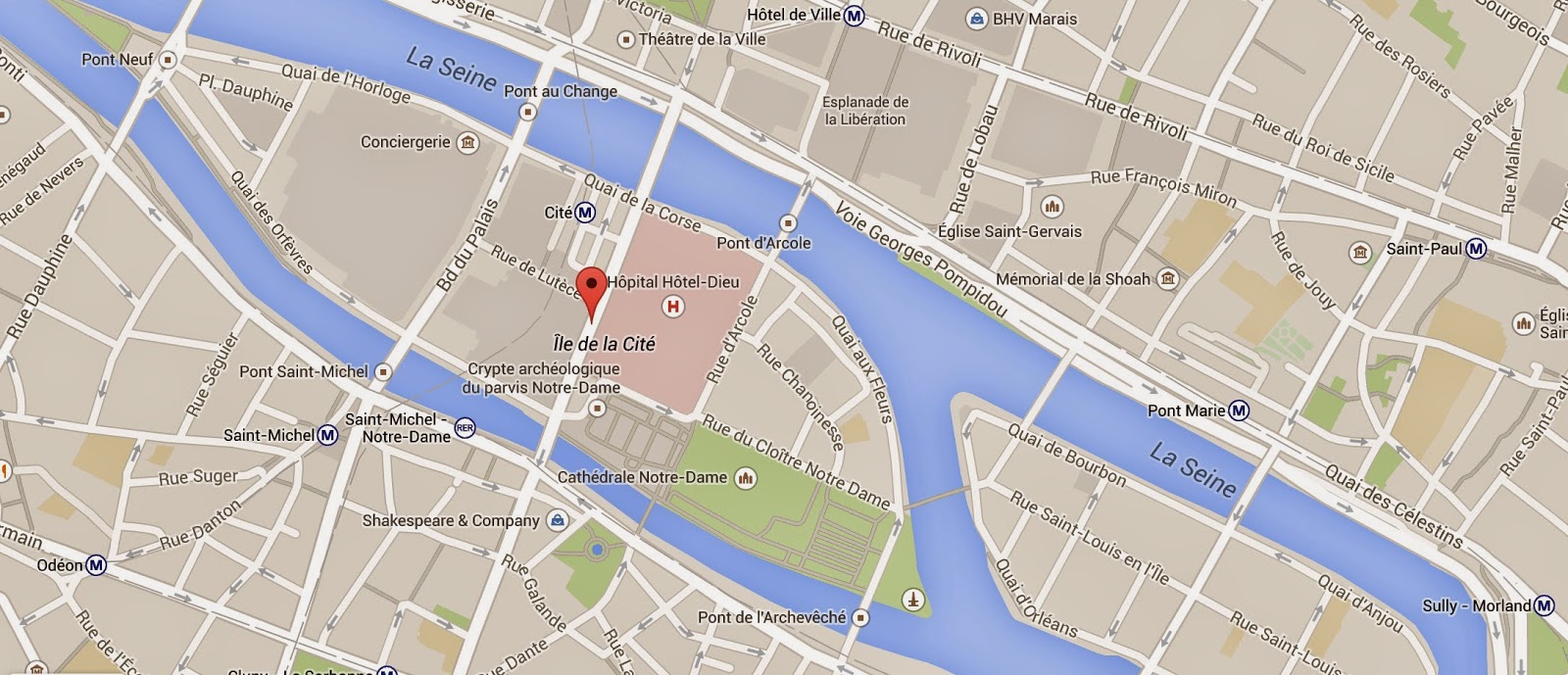
A map of the two islands. The big one is Ile de la Cite , and the smaller one is Ile Saint-Louis.

Getting to the Islands:
  1. If you feel like walking, I'd recommend walking across the Pont-Neuf bridge, Paris's oldest surviving bridge that crosses the Seine river. It has the best views and is a footbridge, so you don't have to worry about being run over by crazy French taxi drivers. You'll arrive at the left (on this map) side of Île de la Cité.  Then, walk past the Conciergerie towards the Notre Dame Cathedral. You'll pass Saint-Chappelle, the fabulous stained-glass chapel on the way (and if you don't see the actual building, you will see the lineup to get in). More on that later.
  2. If you want an even more urban, slightly longer walk, start at the Pompidou centre and have lunch at the Stravinsky fountain. (The Pompidou centre is a modern art museum and library, built in a rather... interesting way. Look up a picture of it.) Then, walk down the Rue de Renard until you get to the Seine, then find one of the numerous bridges to take across. 
  3. If you feel like less walking, take the Metro to the Cité station. The train burrows right under the river and pops up on Île de la Cité. It's not as fun as walking across on a bridge, although a wonderful feeling to pop up from underground, less than 400m from the Notre Dame Cathedral!
Once you're on the islands, note that these islands are the centre of Paris. (When people came to colonize this area, they built their village on these islands because the Seine created a moat around them for protection. Anyway, the gold marker in front of the Notre Dame cathedral is called Kilometre Zero. If you see a sign that says you're 400km from Paris, you're 400km from the
Notre Dame Cathedral.)

Walk towards the big buildings and the Boulevard de Palais (see the map). It's a lovely shaded street (although crowded) and you'll see the lineup for the Saint-Chapelle on the right side of this photo.


By the way, don't try to take this photo unless you want to get almost run-over by crazy French motorcyclists.


Moving on... the Saint-Chapelle is the most beautiful stained glass cathedral I have ever seen. On the outside, it looks... cathedral-ish, but from the inside it is absolutely a fabulous experience. Nothing can describe floor-to-ceiling stained glass windows in intricate patterns, held up only by the wood and stone of the cathedral. When you exit the claustrophobic stairwell and emerge into this room of light, the silence only enhances the colours. No matter HOW LONG you wait in line for the
Saint-Chapelle, you will never regret the time you spent waiting.

Once you leave the Saint-Chapelle, head for the Notre-Dame cathedral. I don't blame you if you find it very hard to find, because it's easy to get lost with all the tall buildings. Just walk facing the traffic to the end of the Boulevard de Palais, then charge down the Quai des Ourfèvres (don't worry, I have no idea how to pronounce it either). You'll see crowds of people and lots of morbidly obese pigeons. Do not feed the pigeons here... they are already well-fed by the tourists. (One pigeon really seemed to like me, and I nicknamed it Fluffy. If you find it, you'll know... this pigeon probably weighs as much as me.)

Push through the crowds and enjoy the awesomeness of the Notre Dame Cathedral, one of the most famous cathedrals in the world.
The Notre Dame Cathedral is... BIG!
By now, you're probably getting tired of waiting in line (like I was) so you might not want to stand around in the massive line for the Notre Dame Cathedral. If you do decide that you want to go inside, bring food for the line wait. I've seen pictures of the inside and I'm sure it's wonderful (although I've never been).
Note: If you have more time in Paris, make Notre Dame a separate trip, which gives you more time to look inside.

After you've been to these major attractions, take some time to wander around. Watch out for pickpockets around Notre Dame, but walk around it quickly and find the bridge to Île Saint-Louis. This island is one of the less crowded parts of central Paris, yet it is in the middle of the city. Find some ice cream and walk to the very edge of the island. There will be people, but it's less well known about than Île de la Cité.
In the bottom corner of Île Saint-Louis there's a little park, and this is a good spot to eat your ice cream and watch the boats on the river Seine.

This is the view from the Quai de Béthune in the morning.

Early morning on Ile Saint-Louis. The Notre Dame Cathedral can be seen in the distance.


And here's a map of Île Saint-Louis. The dot marks the place where the photo was taken.
In general, this island is just a nice place to explore. Walk on the cobblestone streets and immerse yourself in the French lifestyle.

WARNING: Beware of bad weather! Even in the summer, Paris can get rainy. Very rainy. Last year, my dad and I were walking around
Île Saint-Louis after we had finished our ice cream when it started raining. The few drops that materialized from the sky quickly turned into a full-scale downpour. Huge, grey clouds rolled overhead, and darkness covered the city. We ran down the slippery streets and hid in a doorway (many buildings on Île Saint-Louis don't have awnings because there isn't much space). Of course, we were probably the only people in Paris without an umbrella or a raincoat, so we sat down in our doorway and waited for the rain and thunder to stop. Only it didn't. My dad rummaged in his green pack and found some croissants, which were rather squished. From this day on, squashed croissants are known to us as "squassionts". Arcs of lightning laced the sky with brilliant flashes, and still the rain continued. Finally, we decided to make a run for the other side of the Seine, where we could find somewhere better to hang out until the downpour stopped. It was actually pretty fun, running around the island looking for a bridge and dodging puddles. Finally, we ran across the Pont Marie bridge and enjoyed the Pompidou Center until the rain stopped. Overall, not a bad afternoon in Paris. What I learned from this experience: Bring a map that doesn't need a WiFi signal to work.

Anyway, I hope this has been interesting reading for you, even if you're not going to Paris! If you are, stop by the next time you're on Île de la Cité, and maybe you'll find Fluffy the Pigeon.