Travel, mishap, and adventure in a beautiful and bizarre world.

Showing posts with label Locations. Show all posts

Wednesday, 29 April 2015

Island of Maui (Part 2: Accommadation and Hazards)

Okay, if you clicked on this expecting a serious and informative post about Maui, you've come to the wrong place. Lately, I've been doing a lot of "useful" posts, but I want you to read for entertainment as well as learning important-sounding stuff. Let me be honest and upfront here: You probably won't get much useful information out of this at all. But maybe you'll laugh a little. Alright, end of rant. Moving on...


ACCOMMODATION ON MAUI: 

The first thing you want to do when you go to Maui is finding out where you're going to stay. The best way to book an accommodation is by going to the condo or hotel's website. VRBO and Tripadvisor are also useful sources for reviews and booking.  However, those advertisers can be very pesky, and they'll tell you that a hotel room is "oceanfront" when in reality it's six feet underground (more or less). To outwit them I'd recommend following the following guide.


Decoding different meanings for accommodation locations:
Beachfront: See plenty of screaming beachgoers and not much actual beach in this less than idyllic setting. If you're lucky, your accommodation might not be completely blocked by palm tree trunks.
Ocean Front: This is actually an Ocean View, but Ocean Front sounds way better doesn’t it.
Ocean View: If I give you this telescope, can you make it out? Just in the corner there, no, over there, just look past that shrub and…Is that a mountain? Well it might be a glimpse of the ocean. Ok, ocean view then. 
Garden View: All you will see is this lumpy green everywhere outside your windows. Just foliage. Maybe a little bit of dirt if you’re lucky. 
Scenic Mountain View: This could be more accurately named “Parking Lot View” because usually the parking lots are behind the resorts, and so are the mountains, but what sounds better?
Traditional View: Also known as the “Cheap View” or “Garbage Can View”. These are the resort rooms that are situated in the very back, right on the road next to the McDonalds outlet over there. 
Natural Paradise View: If you love dirt, you’ll love the Natural Paradise! Located underground, the 5-in window in your luxury suite will give you a view of all the local ants, worms, and pill bugs. 
Beautiful Budget View: Don’t ask. Please. 

Beachfront accommodation.

Garden view at its best.

Now that you've decided what accommodation type to look for, it's time to figure out where to book a place to stay. If you're wondering where to stay in Maui, here's another list that conveniently points out the pros and cons of each area: 


Where To Stay In Maui:

Kapalua: Yay! Where are we? I haven't seen any humans in the last week I've been here. Well, the tour guide brochure said this area is secluded, but I wasn't thinking of this exactly... Okay, time to forage for food! (In all seriousness, Kapalua is a very nice place to stay if you want a quiet resort area, but it's a 20 minute drive to... basically anything.)

"Time to forage for food!" This is Kapalua (when sunny).
Napili: Some older condos, most surrounding beautiful Napili Beach. Again, it's a pretty isolated area. Also, it rains a lot here. 
Kahana: Eh. Quiet and calm, but there are definitely more fun areas to stay in Maui. I guess you could stay here if you really hate parties or something. 
Honokowai: See Kahana. 
Ka'anapali: Out of all the areas in West Maui, it's the busiest and loudest. But it's also got great beaches, great resorts, great shopping, great activities and great food. 
Beautiful (and windy) Ma'alea.
Lahaina: Lots of stores and restaurants, but there isn't much actual accommodation (or parking, for that matter) here. No actual "beach" here. 
Ma'alea: What? I can't hear anything... It's too windy here! This is probably the windiest place in the entire state, but on a happy note look at my outdoor BBQ-- it's been beautifully sandblasted. However, this area is convenient (being between south and west Maui), it's quiet, and the beach is nice for walking. 
North Kihei: Ew, the beaches are gross and it's too windy here. 
South Kihei: Beautiful beaches, shops, restaurants, barely any rain (ever). Although crowded and sometimes noisy, it's pretty nice here. 
Makena is quiet, but it's also very picturesque. 
Wailea: Possibly the most beautiful place to stay in all of Maui. Paradise, beaches, tropical atmosphere, not isolated and not overcrowded-- the only catch is the price. 
Makena: Prettier than Kahana and Honokowai (and with better beaches), relatively isolated, and quiet. 
Hana: Stay here for awesome nightlife, you crazy party animal! (Just kidding.) Very isolated, with some nice beaches. Being on the tip of East Maui, you'll either have to drive there or fly in. 
Kahului: The only reason you'd stay here would be closeness to the airport, and why would you do that? 

~~~~~~~~~~~~~~~~~

Another integral part of travelling is knowing and understanding the risks. Maui is a pretty safe place, but from sharks to rabid geckos to rocks that attack your foot, it's important to learn about how to deal with these hazards. 
*NOTE: I'm doing this for your entertainment, which means I probably don't have your best interests in mind. If you actually follow my advice on this, you probably deserve whatever happens to you.*


MAUI'S HAZARDS: 

Gecko: If you find a gecko in your condo, don't worry. It probably got in through your air conditioner. Most species don't bite, but if you encounter one that does go out to a pharmacy and buy a pacifier to satisfy his/her chewing needs. Once they are calmed down, gently pick it up and push it back through the air conditioner. Problem solved!

I was thinking of an actual gecko, not the
GEICO Insurance gecko, but it looked so cute. Sorry. 

Cockroach/Other Nasty Bug: Put a sugar cube on a shovel, and when the roach climbs on just flip him out the window! Warning: Watch you don't hit the window with the shovel. Warning: Watch you don't let go of the shovel as well as the roach. 

Jellyfish: If you see what you think is a jellyfish while swimming, touch it to make sure it's not a plastic bag. If it hurts you, swim away. If it turns out to be a plastic bag, then it's not a hazard unless you're a turtle.

Turtles: Not a hazard! They're cute but don't try to pet them as they are not pets. If you want them to be friends with you, chase them around while snorkelling. Then, feed them some algae and you guys will practically be besties! Hint: Watch the turtle doesn't bite you when you try to feed it.

Stingray: Just stay away from the tail (which hurts) and take a cool picture with your underwater camera for Instagram.

*insert Jaws music here*

Snake: I'm pretty sure there are no snakes on Maui. If you see one, you're on the wrong island.

Nakalele Blowhole: Don't fall in. Enough said. (A post on this coming up.)

Sharks: Some sharks on Maui are more dangerous than others. While reef, tiger, and bull sharks can pose a threat to swimmers in offshore waters, another species is even more hazardous. I like to refer to them as touristsharkus domesticus. These sharks can be found in many local tourist shops, and their tiny plastic teeth are unbelievably sharp when someone snaps you with them. See the picture at right for a better description. 

The Sun: If you exclude the accommodation taxes, this hazard affects the by far the most people on Maui. Try to avoid being out in the sun between 11am and 2pm, when the rays are strongest. It's easy to get fried when swimming on Maui because the wind and water hides the symptoms of a sunburn. Make sure you wear a strong sunblock (SPF 15 or higher). Ignore any claims of it being waterproof, sunproof, sandblast proof, nuclear radiation proof, etc. and reapply every few hours to avoid a burn.

The oceans of Maui are great for swimming, snorkelling,
and yes, Instagram photos. 
Water hazards: Don't turn your back on the ocean; a wave might sneak up on you and knock you over. Never swim alone, in the mouth of a river, in murky water, or when the seas aren't calm. Make sure you observe ocean conditions carefully, and don't let the island's idyllic environment cloud your judgement. Like geckos, oceans are a powerful force and they need to be respected.

Rocks: As I've found out, toes have well-known magnetic properties and will often attract a rock. Water shoes give you better grip, and they'll keep your feet safe from those pesky rocks.


This concludes my post on Maui's accommodation and hazards. (I know, it's kind of a weird combination.) The next post might be more useful, but it's a lot of fun for me to write about strange things. Hopefully you laughed at something, even if it was the plastic shark.

Well, sea you later! (Hahaha... that was one two many bad puns.)

Friday, 10 April 2015

Island of Maui (Part 1: Beaches)

Maui's a beautiful island-- rich in everything from pineapples to geckos-- even if it doesn't look that big. Despite the fact that their magical credit card machines will suck out more money than you thought possible, I'd highly recommend going there for winter or spring break.
I'm going to split up all the information into a few different posts, but this one's going to be all about Maui's beaches. Future posts will help you decide where to stay, where to go, and what to do if you ever decide to go on a vacation to this tropical island paradise. Even if you've already been, read the next post for a few tips on 9 of Maui's best beaches.

Maui's Beaches:
Out of all the hawaiian islands, Maui has some of the best, most user-friendly beaches. Whether you want to swim, snorkel, surf, or just frolic around on the beach like an idiot, there's definitely a beach for you! Although South Maui has the most good beaches, West Maui has a few gems. I'm not going to review all the beaches (there are a LOT), but I'll describe some of the island's best, from the bottom of South Maui, clockwise around the island. 
A view of Big Beach from the lava point on the north side. 
Big Beach- Nearly a kilometre long and over 30 metres wide, this beautiful golden crescent of sand is amazing to look at. 
Conditions: When waters are calm, the sea is very inviting, but in the winter be aware of large waves. Because it's right at the bottom of South Maui, wind isn't usually much of a problem. 
Crowds: This is a very popular beach, and as a result you'll want to get there early. 
Best for: Walking, frolicking, sometimes swimming and boogie boarding. If you're not a strong swimmer, don't go swim here because the waves break right on the shore, and the surf comes in at strange angles. 
Location: A minute or so past Makena, in South Maui, just north of 'Ahihi Cove. 

Po'olenalena Beach- One of the least used large beaches in the Wailea/Makena area, this beach is one of the island's best spots for snorkelling. 
Po'olenalena is one of the best snorkelling spots in South Maui.
Conditions: The surf is usually quite gentle, and the offshore waters are almost completely free of rock outcroppings. 
Crowds: Unlike a lot of other South Maui beaches, this beach is quiet, calm, and very much uncrowded (although weekends can be busier here). 
Best for: Snorkelling (especially for beginners) is amazing thanks to the clear water and interesting topography, boogie boarding is good (when there's surf) and swimming is great too. 
Location: In South Maui, south of Palauea Beach and in between Wailea and Makena. 

Palauea Beach- Another great beach near Wailea that offers excellent swimming, calm surroundings, and relatively clear water. 
Conditions: Water access is easy, and the gently sloping shoreline is free of rocks. The recessed bay doesn't get as windy as other beaches in the area. 
Crowds: It's a little busier than Po'olenalena beach, but considering the location is certainly one of the quietest beaches in the area. 
Best for: Swimming, and snorkelling around the left side (the right is good too, but offshore waters can be cloudy). 
Location: Near Wailea, and south of Polo beach (in South Maui).

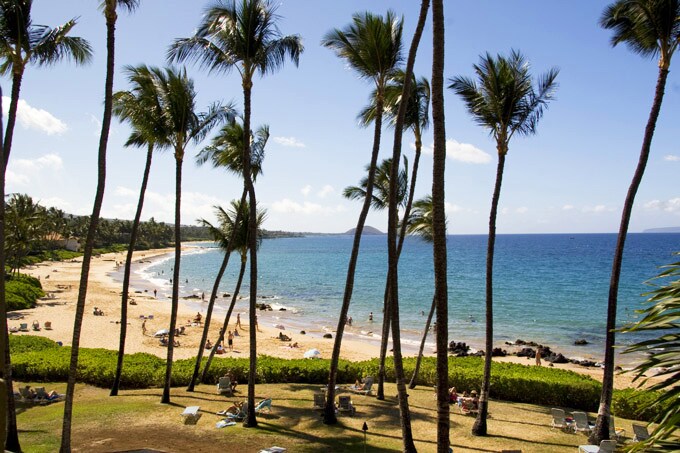
That's it... we're not leaving... EVER! (Wailea Beach isn't usually this quiet.) 
Wailea Beach- Almost half a kilometre long, this classic crescent of sand is a must-go-to beach on Maui. 
Conditions: The setting is picturesque and waters are calm most of the time. In the afternoon, it can become windy so morning is the best time to visit.
Crowds: Unfortunately, you won't find this beach empty (it's backed by the Grand Wailea resort), and parking can be a problem. 
Best for: Swimming and frolicking is excellent here, and the snorkelling is decent at both ends of the beach. Boogie boarding is good at the left side when there's surf. 
Location: This beach is located in Wailea in South Maui, south of Mokapu and Ulua beaches. 

Keawakapu Beach- A long, excellent beach with lots of sand on and offshore, and very clear water. 
Conditions: Mornings are best as with most South Maui beaches, as afternoons can be windy. Even in the winter, the surf is pretty calm.
Crowds: Like Wailea beach, Keawakapu can get pretty busy, especially on weekends and during the winter season. The left side of the beach is less used than the area by the main public access.
Best for: Frolicking, swimming, and snorkelling (which can be good at the northern rocky point at the end of the beach). 
Keawakapu Beach is one of South Maui's best beaches.
Location: In South Maui, in the South Kihei/Wailea area, north of Mokapu and Ulua beaches. 

Kama'ole Beaches- An awesome trio of South Kihei beaches, each a great place for a different activity. 
Conditions: Mornings are best, as the afternoons are windy. Kameole 1 is the biggest and best of the three, Kameole 2 has the same clear water and fine sand, and Kameole 3 has a little more seaweed (and is most used of the three). 
Crowds: You won't find these beaches quiet, as they are some of the most popular in South Maui. Kameole 3 is most used by locals. 
Best for: Kameole 1 is good for swimming and snorkelling (especially at the right end), Kameole 2 is a great place for frolicking and swimming, (decent snorkelling at the rocky points), and Kameole 3 has the most reliable boogie boarding in South Maui, due to bigger waves even during calmer seas. 
Location: In South Kihei, a ways north of Keawakapu Beach. 

Ka'anapali Beach- This beach fronts lots of resorts in central Ka'anapali, and one of the best ways to spend your evening in West Maui. 
Conditions: The entire beach has a fine, sandy bottom (and very few rocks!). During calm seas, the swimming and snorkelling is great, but when the surf's up, don't go in the water. 
Crowds: This beach may not be hidden and untrampled, but you won't be disappointed. There's a concrete path along the beach, and it's a great place for an evening walk or run.
You won't find it empty and untrampled, but Ka'anapali
Beach never disappoints. 
Best for: Walking, swimming (when calm), bodysurfing (in the middle of the beach), and snorkelling (at the north end).   
Location: In Ka'anapali, in West Maui; south of Kahekili Beach Park. 

Kahekili Beach Park- A sandy bottom, clear water, and protection from afternoon winds-- this is one of the best West Maui beaches.
Conditions: A windbreak running north of here helps to protect you from wind, but like Ka'anapali beach, high winter surf can partially erase the sandy bottom and make the water cloudier. 
Crowds: Although less crowded than some other beaches in the West Maui area, it's still a pretty popular beach. Mornings are best here. 
Best for: Walking is great all the time. Frolicking and swimming (when seas are calm), and snorkelling (but you'll have to go farther out). 
Location: Just north of Ka'anapali beach, in West Maui. 

Napili Beach- A small but fun West Maui beach with lots of sand and a cove that blocks much of the afternoon wind. 
Conditions: When seas are calm, it's good for swimming but beware that the steep shoreline causes waves to slap the shoreline and recede quickly, creating an impressive undertow during high surf. 
Crowds: Like most good West Maui beaches, it can be fairly crowded (especially on weekends and holidays). 
Best for: This beach is a great place for swimming and frolicking, as long as the seas are calm. During high surf, sit on the sand and watch the waves. 
A dramatic sunset on the shores of Sugar Beach. 
Location: In Napili (in the northern part of West Maui), south of Kapalua. 

Other beaches: The 9 beaches I've listed in this post are some of my favourite, but there are lots of others. If I gave detailed information on all of them, this post would be way too long. Here are some honourable mentions that you can look up if you're interested or going to Maui:
Best Long Walk: Sugar Beach (Ma'alea/North Kihei area)
Best West Maui Snorkelling: Black Rock (Ka'anapali) and Honolula Bay (north of Kapalua)
Best Secluded Beach: Pa'ako Beach (past Big Beach)
Best West Maui Swimming: Kapalua Beach (Kapalua)
Best Less Known Beach: Black Sand Beach (Makena)

Thanks for reading! The next Maui post will be all about where to stay, and also how to find the best accommodation (does "oceanfront" mean actual oceanfront, or "you might just make out the ocean past those palm tree trunks"?).

Finally, if you have any travel advice, tips, or feedback of your own, leave a comment below :)

Sunday, 8 March 2015

My Tour de France Experience

I know, I know. Why do I always have to post travel stories? Sorry. If you don't want to read about the Tour de France, then you'll just have to wait a few weeks until I make another travel advice post. But if you need something to do or will be visiting France next summer, read "Information". If you want to read a story, scroll down to where it says "Story." There's also a cool video from the Tour de France at the end. Happy reading!

Information: 
First of all, the Tour de France is an annual bicycle race that is based primarily in France (duh) but it also occasionally passes through surrounding countries. Over 23 days, the competitors from various countries complete 21 stages (étapes), over 3000km. The final stage always ends on the Champs-Elysees, and leader at the end of the race gets a highly coveted yellow jersey. (The cyclists can't just all go to Walmart and pick up yellow shirts after the race; I guess there's some symbolism involved here.) There are also more coloured shirts for best climber, best youth cyclist, and best sprinter. Every summer, people come from all over the country (and other parts of Europe!) to watch different stages of the race.

If you want to see the Tour de France, you have two options.
#1) Watch the sweaty cyclists race past you in a blur as you stand on the roadside along the racecourse.  No matter how much you de-blur your photos, they will not even be worthy of Instagram.  OR:
#2) Go to the city/town a stage of the Tour is starting in, and take part in the hours of festivities before and after the cyclists leave to begin their next stage. This includes floats, prizes, food, and even a few Instagram-worthy photos.
A map of the 2012 Tour de France course.
Well, there's certainly an obvious choice here (and it's not #1). So in 2012, my family went to Limoux to see the start of a stage of the 99th Tour de France.
Even if you don't like biking, it's a pretty awesome event to get to watch the start of a stage. If you're in the right area of France at the right time, I would definitely recommend going. An added bonus is the fact that there's always lots of food.

More information: http://www.letour.com/de/

Story: (My Tour de France experience)

It's six in the morning when I'm woken up. I sit up and look out the window at our garden and open up the windows, feeling the fresh air of Southern France on my face. I'm trying to savour the moment when I hear a strange noise downstairs. *splurch slurp chomp splorch* Oh, it's the pet cat eating breakfast. So much for savouring the moment. Now I remember that today we're going to watch the Tour de France! Yay! I'm so excited! But I still want to go back to bed.
Before...
After breakfast, we drive through the morning light for an hour and a half. Why is everything so dark? Oh yeah, it's because I woke up at SIX IN THE MORNING to get dumped into a car where the door handle gets in the way of my jacket/pillow so I can't sleep. Trust me, there are serious considerations when choosing a car to rent. You have to find one where the inside of the car doesn't have the window button in the wrong place because it wedges into your ear when you're trying to relax... got a little off topic.
We get to the outskirts of the town of Limoux, and I'm awake thanks to the guys with little plastic glow sticks directing us around.
The good news: We got here early so we should get a great parking space close to city centre, where the Tour de France starts.
The bad news: "Good parking space" constitutes as "only a 2km walk!"
*sigh*
...After!
The walk was actually pretty interesting. We got to see the local wildlife (pigeons of Limoux), I almost tripped over a Tour de France banner, and I saw a squad of these tiny cars herding people around. They were actually part of the Tour de France organization, but I didn't know that until later. (I was a gullible kid back then... thought that it was okay to use a group of cars to herd a bunch of people.)
After about half an hour, we got to the main street of Limoux, where the organizers were just setting up. There were still two and a half hours until the actual festivities began. Almost as if I didn't have to get up at six in the morning. We were able to pass the time by eating croissants, getting Tour de France t-shirts, and taking pictures of the aforementioned local wildlife.
Soon after, they started playing music and everyone crowded around a big stage in the centre of a nearby square. The mayor of Limoux and some important-looking people wearing suits welcomed us to the Tour de France, etc etc. Then, the crowd of people rushed back to the start line, and we got to see a giant parade of the Tour's sponsors.
Each company was represented by an elaborately decorated float with lots of cars around it. Besides looking fabulous, lots of the floats threw free samples into the crowd as a promotion. I got a bag, a hat, a keychain, a (non metal) water bottle, a pen, and my favourite-- a blow-up plastic pillow from the Ibis hotel chain.
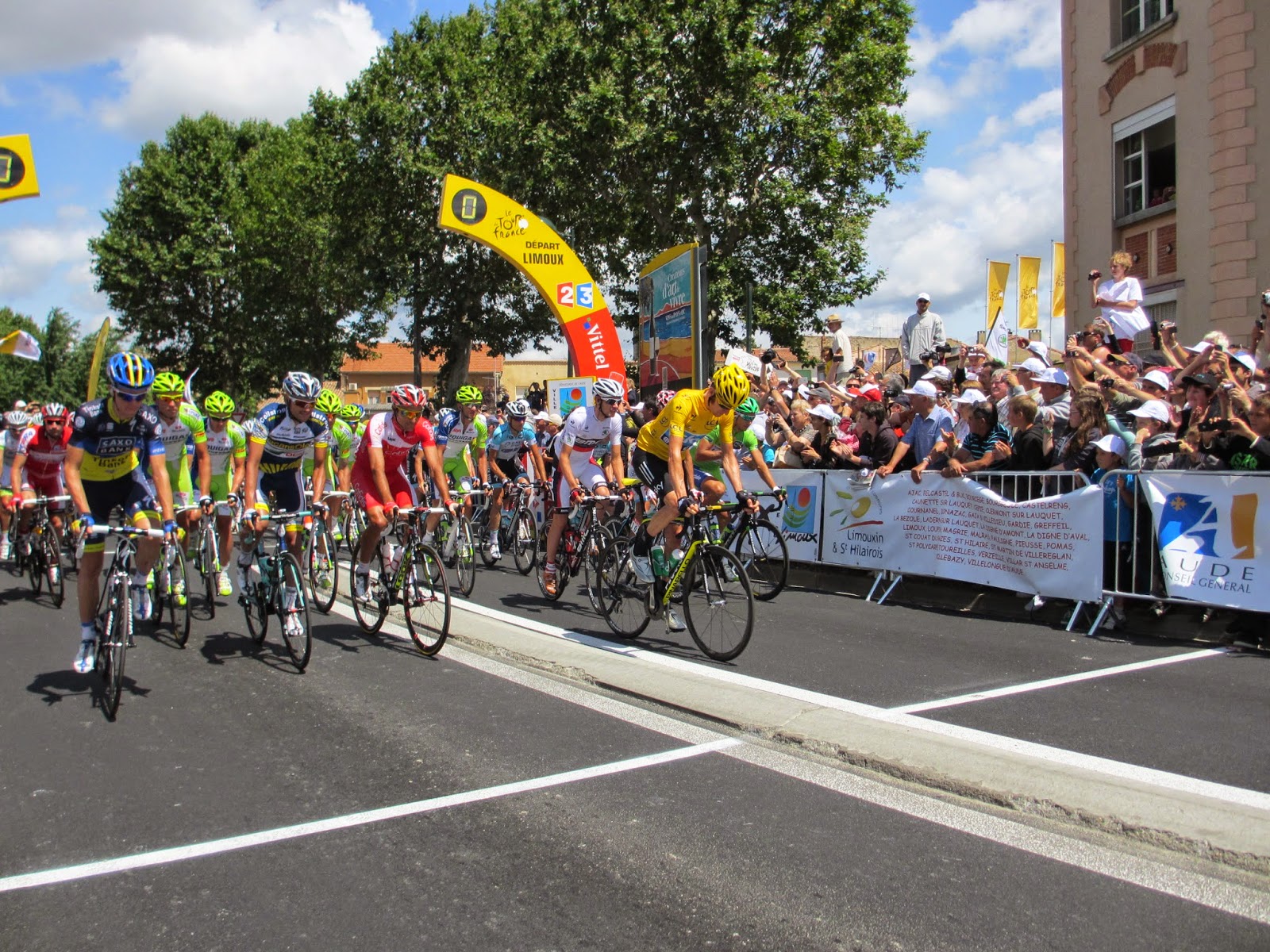
"The guy with the yellow jersey"
The crowd was at least ten rows deep, but I was lucky-- right in the front, mashed into the metal gate that ensures nobody falls out onto the road and gets run over by a float. (That would be a pretty embarrassing way to die; getting mowed down by a truck that throws blow-up pillows as free samples to everyone.)
I have to say, I was pretty impressed with the experience so far-- and I hadn't even seen the cyclists yet! The stunning ambiance is like a spectrum of colours... (insert fancy vocabulary here)... it was good.
And they're off!
Finally, the floats were replaced with cyclists, all grouped in teams, with very expensive-looking bike-racing suit things. According to my travel diary, "the guy with the yellow jersey was in the front" (excellent observations by my 10-year old self). The herding cars moved out of the way, and the music was replaced by a stunning silence. Two massive clocks on either side of the start banner showed the seconds before the cyclists could leave. I don't think it was really necessary to vocally count down from 50... but never mind. I'm ruining the Tour de France Vibe here.
5, 4, 3, 2, 1... GO! My thoughts, in order, after the cyclists started down the road:
1) MY CAMERA! This is definitely gonna make it onto Instagram! *fails to take decent video because of all the people screaming around me*
2) What am I doing? Savour the moment, you idiot! *puts camera in bag* *watches for one second*
3) Okay, let's get that video! *pulls out camera*
4) Darn it they're around the bend.
5) Okay lets go home. I'm hungry.
6) Ooooo airplanes flying overhead! They have contrails the colour of the French flag! *gets decent photo of airplanes*
7) That was pure genius... I missed the cyclists but I got the airplanes.

A great way to end my experience with the Tour de France 2012.
It really was an amazing experience. Luckily I did get some decent photos, some of which were of the natural wildlife (they are not included in this post.) I also gained about 30 pounds in croissants-- my family basically rolled me back to the town we were staying in. To conclude I'm definitely going to remember the 99th Tour de France for a long time, and I hope one day I can watch the beginning of another stage... even if it means waking up at six in the morning :)

And to conclude, here's a video of the Tour de France. If you find yourself in France at the right time, in the right place... you just might be able to watch one of the world's greatest bike races.


Sunday, 18 January 2015

One of the World's Highest Bridges: Miallu Viaduct

I know, I know. Another stupid bridge. Yes, I want you to go see a bridge. Actually, this bridge is pretty awesome. And besides the bridge itself, there are lots of other great things to see around this area, including the town of Miallu and the Tarn Gorges. This is the Miallu Viaduct.

First of all, let's clear up the pronunciation difficulties. It is not MEE-ow Viaduct. It is not The Viaduct of Cats. It's also not the mee-AH-loo Viaduct. If you tell your friends in the French town of Servian that you are going to visit the mee-AH-loo Viaduct, they will just look at you quizzically and wonder where you learned your (bad) French. Trust me, I've done that before. Pronounce it: mey-AU.
Okay. With that out of the way...
The Miallu Viaduct is a 394,000,000-Euro bridge that spans the valley of the River Tarn in southern France. It was built so people living on one side of the valley could get to work in places like Clermont-Ferrand (on the other side) more quickly. It bypasses Miallu completely, so why it's called the Miallu Viaduct I have no idea. Before the bridge was constructed, everyone had to drive into the valley and back up the other side, causing traffic jams in the middle. (It must have been a really annoying problem if they spent almost 400 million euros on it.)
You won't get this cool a view... unless you take a helicopter. Photo credits to www.wikipedia.org
 Anyway, this bridge is a fabulous architectural wonder. If you're less than a couple hours away from it, I would highly recommend going there. But the question I'm answering is "Is it better to to view the views from on top of the Miallu Viaduct, or drive into the valley and see the viaduct, but not be able to look down into the valley?"
The answer is surprising, but not once you've driven over the viaduct.

First, let's define where the Viaduct actually is. The nearest large city is Montpellier, which it is about an hour drive north of. I could say it's in the centre of southern France, if that helps.
*note* There is currently construction about 20 minutes from the viaduct on the A75.

My Experience
The awesome view of the viaduct in the bottom of
the Miallu Valley.
When I visited the Miallu Viaduct with my family, we incorporated it into a day trip with a visit to the Tarn gorges and the nearby towns. Coming from the south, we drove along the E11 and turned off at the visitor centre to hang out and get some cool posters. After that, we drove into the valley on the D41A (this will make more sense when you see the map) and were able to get some good views of the viaduct. There's a really nice viewpoint right at the bottom of the valley where you can pull over and get out of your car, looking up at the bridge. After that, we drove back up the other side, on the D41. We passed Miallu and followed the D809 along the banks of the river. There are several nice towns along here; Aguessac, Compeyre, La Cresse, Rivière-sur-Tarn, Le Rozier, Les Vignes, and others. (By the way, if you stop in Les Vignes, there's a restaurant with a beautiful view over the river... just don't order the chèvre salad.) After having lunch in Les Vignes, we drove around the Tarn Gorges. There are several great viewpoints, and if you can stomach the bumpy road, there's much beauty to be discovered in this region of France. On the way back, we got out of Miallu via the D911 instead of the D41. This road took us a few minutes north until we found a complicated traffic circle that got us onto the A75, going south. (It's hard to find other roads that get you onto this highway, most of them go under the viaduct.) This is where we went through the toll booth and got onto the viaduct.
Here's a map of the Miallu area. NOTE: Highways D992 and the E11 (aka big orange line) do not intersect
(the D992 goes under the viaduct). Also, the D911 and E11 meet up farther north.  

MY AMAZING JOURNEY ACROSS THE VIADUCT...
Was surprisingly dumb. Well, no. It felt cool, but all you can see are the 3m- tall plastic barriers and the huge suspension lines as you pass under them. Had I not known that the viaduct existed, I would have been thinking, "oh hey why'd they stick these stupid poles here on this random stretch of highway...?" The change is almost unnoticeable.

So to answer your question... By all means, driving into the valley is the best way to see the viaduct.  It also gives you a great opportunity to discover the Tarn Gorges, instead of just driving over the viaduct, past the town of Miallu, then turning around and going back. Actually, don't even bother with the bridge unless you have to. However, if you are planning a trip to the South of France, you might want to keep reading for some more tips about how to spend your day at the viaduct.
If you turn around and look out the back of the car window
after crossing the viaduct, this is what you'll see.

My Advice
1a) If you are staying close to the Miallu Viaduct: Devote one day just to exploring the valley and the viaduct, and come back for a more thorough trip around the Tarn Gorges.
1b) If you aren't staying close to the Miallu Viaduct: Get up early, and spend the day exploring the viaduct, the Tarn Gorges, and the surrounding towns and villages.
2) Going into the valley is essential, going over the bridge is not. It's fascinating to go into the valley where you'll be able to really appreciate the huge viaduct. If you're in a rush to get back to the town you're staying in and want to say you've been on the bridge, you can go over, but there will be nothing to see except at the very end after you've crossed the viaduct (see picture at left).
3) Make sure you go to the visitor centre (if you want to buy that overpriced plastic Miallu Viaduct placemat on your wish list!). Actually, most of the things in the visitor centre are really nice, and you can look at models of the viaduct and watch a short movie about how it was built. It's a great learning experience, a lookout gives you great views of the viaduct, and most importantly... there are bathrooms.
Drive up one side of the Tarn Gorges for this spectacular view. 
4) Visit the towns! In France, it's not enough to be a tourist; you have to immerse yourself in the French lifestyle and culture. Go for a swim in the Tarn Gorges, eat at a restaurant beside the river, go on a hike, and talk with the locals (we got an awesome beach ball from a restaurant owner in Les Vignes). Don't just go to the Miallu area to see a big bridge, you have to enjoy it.
5) Don't stress over food. Bring breakfast in the car, and when you get to the Tarn gorges, park your car where there's a nice view and eat your squassionts (squashed croissants, a reference to my time in Paris). It gets very hot in the summer, so bring along LOTS of water. For lunch, eat at one of the local towns along the gorges. For dinner, buy a baguette (or whatever) from a café and eat it in the car.

Well, I hope this helps you if you ever find yourself in the south of France with a day to spare. And if it wasn't useful at all and you're never going to go see the viaduct, well, you just read three pages of me ranting about overpriced placemats in the visitor centre. Which is okay, too.

Friday, 2 January 2015

Transportation Around Paris

By this point, you've probably read several posts about the various attractions in Paris, France. However, you need to know the various options available for travelling around the city, and
this post will list their convenience, cost, and fun-ness.

#1: Walking:      Cost: None      Convenience: 3/5        Fun? Depends where you are in the city
Pros- Walking is great exercise, and there's way more to see travelling on foot than underground in a Metro station. It's very inexpensive (you just have to eat more food/fuel!) and you can be mentally lazy and not have to worry about which stop to get off at. Some areas of Paris are better than others, of course, but walking is a great way to really appreciate the city.
Cons- It's sloooow. And if you're in Paris during a rainstorm (which isn't exactly uncommon), you're not going to have much fun in the forty-five minutes it takes you to get from the Louvre to the Luxembourg Gardens. So it's easy, but not always convenient or fast due to weather issues. And you also have to not trip over any natural wildlife (aka pigeons).

#2: Metro      Cost: 1,70 Euro      Convenience: 5/5   Fun? The first time, at least.
This is a typical Paris Metro train.  
Pros- It's probably the most efficient way to get yourself around Paris, certainly for the price. The trains are always on time, and you can save money by paying about 13,70 Euros for a 10-pack, which I recommend. The ticket is effective until you leave the Metro, so you could ride around underground for a whole day and only pay 1,70 Euros. It's also super fun to take the Metro into Paris, because you're underground coming into the city and suddenly pop up right amongst the amazing architecture, just blocks away from some national landmark. You don't have to walk far to find a station, because they're almost everywhere in central Paris.
Cons- Not super interesting once you've been riding it for an hour, so try to incorporate Metro-ing with walking around the city, since all you're seeing is the inside of a tunnel. You don't really get much exercise (except for climbing the stairs...) But overall, it's definitely the most convenient form of transportation in Paris.
TIP: If you've seen the sights of Paris, this is a fun way to discover even more. Walk to a random Metro station. Pick a line and roll a pair of dice to see how many stations you go before getting off. Explore that area, then walk to a different station and choose a different line to go on. Take it in the opposite direction. Go aboveground and explore. Repeat.

*scroll down for Metro Map*


#3: RER      Cost: Can vary      Convenience: 4.5/5      Fun? Sorta
At the Gare du Lyon, you can take SNCF trains or the TJV
outside of the city as well as change RER or Metro trains. 
Pros- This is a sort of suburban line that goes further outside the city, although it has several stops in central Paris and in some cases may be more convenient (it is faster and has fewer stops than the Metro lines). You can use a Metro ticket on these, but only in the central part of the city. If you are travelling to other zones (farther out of the city) you'll need to pay more for a separate RER ticket. If you're coming to Paris from the CDG or Orly airport, you'll take the RER into Paris.
Cons- Just like the Metro, it's only aboveground in the suburbs of Paris, and just when it gets interesting the RER trains go underground. You're better off to use the Metro system in central Paris, because it'll be easier to find a stop. Tickets can be a little on the expensive side if you're outside of the city centre. You also don't get much exercise on the RER (although you could run up and down the train if you wanted to).

As you can see, the Paris Metro/RER system is very complex...
#4: Bus      Cost: 2 Euro        Convenience: 3.5/5      Fun? Until there's the inevitable traffic jam
Pros- For short rides, travelling aboveground is definitely more entertaining, and you can also familiarize yourself with the city if you look around. You can use Metro tickets for the bus, but you can't transfer from a Metro to a bus using the same ticket. Packs of ten are available for 13,30 Euros. I'd recommend it if you're going to be on the bus a lot.
             Two-digit numbers mark Paris city buses, 
             three-digit numbers mark suburban buses.
Cons- You need to get another ticket every 90 minutes, which can be annoying if you're riding for a long time. Traffic jams can help you learn the French curse words pretty quickly (just listen to everyone when you get stuck in the middle of the city). They're slower than the Metro, although useful during bad weather.
Bus Lines Outside Paris: The Roissybus runs from the CDG airport to central Paris, but I do not recommend it. You get no view, and it's really frustrating when there's a traffic jam. It takes about an hour and a half to get to Paris from the airport, and I'd recommend going on the RER instead. (Tickets from CDG to Paris cost 10 Euros per person...Mon dieu!)


#5: Taxi      Cost: A lot       Convenience: 4.5/5      Fun? Not when you see the price meter
One of the taxi stations along the Champs-Elysées
Pros- The Parisian taxis are safe and reliable, and you can catch a taxi by hailing one on the street or going to a street corner taxi station where they queue. Available taxis have a long white light on the roof. There are over 15,000 taxis in Paris, so finding one is usually not a problem. They are certainly very convenient, and if you're tired and don't want to memorize the Metro map, are a good idea.
Cons- However, taxis in Paris are super expensive because of the traffic, and unless you have to get somewhere urgently or are very tired, I wouldn't pay the extravagant taxi fees. I would not call for a taxi, because they charge for the distance travelled to pick you up. (I learned this the hard way...) Use the Metro/RER/Bus unless you want to treat yourself.

#6: Driving   Cost: n/a      Convenience: 1/5      Fun? If you're driving it's not fun...
Traffic jams aren't exactly uncommon in Paris...
Okay. DO NOT DRIVE YOUR CAR IN CENTRAL PARIS. The parking is impossible, driving can be a terror in the city, and if you want to park on the street it costs 2 Euro an hour and you're limited to two hours. Underground lots are even more expensive. Car rentals are expensive and it's going to take you forever to get where you need to go, because there are so many cars in central Paris. If you do bring your car (which you shouldn't have), park it outside the city and forget about it. Take the Metro, bus, or ANYTHING else but DO. NOT. DRIVE. A. CAR. IN. PARIS.

#7: Biking    Cost: Varies    Convenience: 3.5/5     Fun? YES!
One of the Vélib bike stations in Paris.
Pros- The city of Paris operates the Vélib bicycle rental program using three-speed bikes which you can pick up at stations or "service points" scattered around the city. You can pick up a bike at any Vélib station and turn it in at any other. The prices are affordable (1,70 Euro per day, and 1-4 Euros per half hour depending on how long the trip is). You need to get an account and money will be taken out if you damage the bike or return it overtime. You have to be 14 or older to use a bike. These are great exercise, and are faster than walking.
Cons- Although a great way to see the city, the bikes aren't super fast. Use them mainly for cruising around, because they won't get you across the city very quickly compared to the Metro. You do need a credit card with a microchip to use the bikes, but this is not usually a problem for us Canadians.


#8: Ferries    Cost: 15 Euro/day   Convenience: 3/5    Fun? Definitely.
Is it a bird? Is it a plane? It's the Batobus!
Pros- Batobus is a ferry service on the river Seine that makes eight stops on a circular route in the central city: The Eiffel Tower, the Musée D'Orsay, Saint Germain des Prés, Notre Dame, the Jardin des Plantes, the Hotel de Ville, the Louvre, and the Champs-Elysées. It's a great way to see the city without memorizing bus routes, and it departs daily at 25 minutes intervals from 10:00AM to 7:00 PM. Once you buy a ticket, you can use it for the whole day regardless of how many time you get on and off.
Cons- Although fun, the Batobus only stops at locations on the river Seine, meaning you'll have
to find another transportation method to get to and from your hotel, unless it's right on the water. It also doesn't run in January, so plan accordingly (although it's unlikely you'll be in Paris at that time). I found the Batobus to be a bit touristy because it only visits the main attractions, but the views are stunning.

Here's a map of the Batobus route. It makes eight stops at major attractions along the river Seine. 

Overall, each method of transportation has its pros and cons, and you need to decide which one works for you. Remember to memorize your routes before you go somewhere, because opening a map and trying to figure out where you are will definitely make you a target for pickpockets. If you've lost you're way, downloading the Paris Metro app on your phone will make you less conspicuous, but don't let anyone see which pocket you put your phone in.

Most reliable: Taxi
Most convenient: Metro/RER
Most scenic: Ferries/Biking
Worst way you could possibly drag yourself around the city: Driving

This is just a brief summary, so I'd recommend checking THIS LINK for useful information should you actually be going to Paris. Have fun!


Other useful websites: 

Paris Metro:
http://en.wikipedia.org/wiki/Paris_Métro

Paris RER:
 http://parisbytrain.com/paris-rer/

Bus Map: http://www.ratp.fr/informer/pdf/orienter/f_plan.phpnompdf=bus_paris&loc=reseaux&fm=pdf

Vélib Website: (in French)
http://en.velib.paris.fr

Batobus Website: (in French)
http://www.batobus.com

Friday, 26 December 2014

Gardens In Paris: Tuileries & Luxembourg

You've probably heard about the two most famous gardens in Paris. Even if you get easily bored just hearing the word "flowers" (which I do!) these gardens are easy to enjoy, even if you're walking through them on your way to the next Metro station. This (rather short) post will compare the Tuileries and Luxembourg gardens, so if you're in Paris and have limited time, you can chose which one you want to go to.
TIP: I would highly not recommend giving yourself three or four hours just to see the gardens, because this isn't the kind of thing that you make a separate trip on the Metro for. I don't like it when these are listed as "attractions" because they're really just a part of the city and lifestyle. I'd recommend walking through one of the gardens on your way to a different attraction. Just naturally incorporate them into your day, instead of planning everything.

#1: The Tuileries Gardens
Location: Between the Louvre Palace and the Place de la Concorde, in the 1st Arrondissement.
Distance: 1km and about 15 minutes end-to-end if you don't stop or walk along any side paths.
Description: This garden provides a great contrast between forest-y and wide paths. The main walkway (Alée Centrale) runs straight through the middle of the garden, towards the big pond at the end. The gardens are very popular, but they're big enough that you can find your own place in its depths. Huge stone and bronze statues decorate the gardens, surrounded by colourful flowers. There are several snack stands on the main path, especially by the octagonal pool. Some are touristy and others are very nice. We liked the ice cream from Antonio's (the stand with the fat angel logo). You really need to be careful of pickpockets here, especially on the main path near the Louvre. I'd recommend staying on the other paths that are concealed deeper within the trees; there are less pickpockets.

Here's a map of the Tuileries Gardens in Paris:

#2: The Luxembourg Gardens
Location: Just south of Sorbonne University, in the 6th Arrondissement.
Distance: 750m and about 12 minutes if you walk quickly (from Rue Auguste Comte to Rue de Vaugirard).
Description: Where the Tuileries are rich and forested, these gardens are open and spread-out. When you see the Luxembourg Palace after going around (and hopefully not IN) the main pool, you'll be stunned. The Fontaine Médicis is also worth a look, and the many side paths winding around the gardens are great for exercise and very photogenic. You can find shade along the edges of this garden, and you can get to it quickly if you take the Metro to the Luxembourg station. These gardens can get crowded, but the wide paths and sprawling landscape make it easy to forget yourself and just spend a whole afternoon in the gardens. Unlike the Tuileries gardens, we had no trouble with pickpockets here. Another plus is that it's very difficult to get lost in these gardens: you don't need a map because the Luxembourg Palace and the octagonal pool can be used as reference points. Take your time in this garden, especially on sunny days when the flowers and trees are lush. There's a lot to see, and you need to slow down to really appreciate it.

Here's a map of the Luxembourg Gardens:

Well, I hope this guide has helped you to learn a little more about the two main gardens in Paris! (Even if you're not planning a vacation to Paris, check out some of the travel advice blog posts about the next time you go travelling.) Final tips about the gardens:

1) Never just go to a garden. Always incorporate it into the other attractions you are visiting.
Attractions near the Tuileries Garden include: The Louvre, Place de la Concorde, Place Vendome, Madeline, Champs-Elysees, Opera (some distance away), and Arc du Triomphe (some distance away)
Attractions near the Luxembourg Gardens include: The Pantheon, Sorbonne University,
Cluny Museum, Notre Dame Cathedral, Saint-Chappelle, and Musee Rodin (some distance away)
The Tuileries Gardens in the summer.

2) Always visit these gardens in the summer or spring, if possible. They are much more interesting when everything is lush and green. Autumn can be interesting, and winter is just boring. If you visit the gardens in the summer, bring a hat and sunscreen.

I hope you enjoyed reading this blog post! If you are going to Paris, also read the
4 Walks In Central Paris post for ideas on where to walk and how to incorporate the gardens into your daily life in the city.

And don't feed the pigeons (they are already overweight).


Monday, 24 November 2014

4 Walks in Central Paris

You've probably read about the different attractions in Paris, but what you won't know is how to get around the city to those attractions. Sure, you can take dumpy side streets to get to the Eiffel Tower or wherever, but there are much nicer routes that connect these attractions to each other. Also, there are other parts of Paris you want to avoid, especially at night (around Montmartre, Bois de Boulogne, Moulin Rouge, Barbes-Rochechouart, and Pigalle). These are some good walks to take that can connect you between attractions. When in Paris, I would plan out a route --for example, the Louvre to the Arc du Triomphe-- and then take the Metro back. This can also depend on the location of your hotel, so keep that in mind when planning walks.


1) Louvre - Tuileries Gardens - Place de la Concorde - Champs-Elysées - Arc du Triomphe

Distance: 3.3km    Walking Time: 40-50 mins  Time/Interest Rating: 2.4/3

Awesomest Moment: When you're standing at the Arc du Triomphe du Carousell and see the Egyptian Obelisk in the distance, and behind that, the Arc du Triomphe, all perfectly centred.

Brief Description: This is a great walk if you want to see the Axe Historique all at once. (The Axis is the string of historic landmarks and monuments in an almost straight line towards the northeast. If you do one walk in Paris, this is it: After you look in the Louvre, head towards the
This picture shows the perspective of the
Axe Historique.
Arc du Triomphe du Carrousel (basically a mini Arc du Triomphe). Then, relax in the Tuileries Gardens and try not to get pickpocketed by the overly affectionate pigeons. From there, charge through the Place de la Concorde, but get across the roundabout before you look at the lovely Egyptian Obelisk. Getting run over is not a good way to start your walk. Then, make your way up the Champs- Elysées. The first third or so is tree covered, but not super interesting. Consider finding a Metro station to get closer to the Arc de Triomphe if you don't want to walk the whole way. (The Champs-Elysées Clemenceau, Franklin D. Roosevelt, and George V. stations are all positioned along the Champs-Elysses. Most of the interesting stores are between the Franklin. D. Roosevelt and George V. stations, and the Champs-Elysées Clemenceau station is located 2/3 of the way down the tree covered section.) Of course, the Arc du Triomphe is breathtaking as it gradually comes into view.


2) Musée d'Orsay - Esplanade des Invalides - Tour Eiffel

Distance: 2.5km   Time: 30-40 mins   Time/Interest Rating: 2.5/3

Awesomest Moment: The moment when you get your first real glance of the Eiffel Tower, and wonder how you could have possibly missed it before... it's actually quite difficult to see until you pass Les Invalides!


Brief Description: This walk is a fun way to get to the Eiffel Tower (see the earlier blog post about it.) If you want to approach from the Champ de Mars side of the Eiffel Tower, this is a good way to incorporate it into your day. I would highly recommend going into the Musée d'Orsay, even if you're only there for an hour or two. From the Musée d'Orsay, follow the Quai Anatole France until it merges into the Quai d'Orsay. This boulevard is rather busy, but it is shaded.  Enjoy the fabulous views of the Seine river as you walk along its banks. About five minutes from Les Invalides, you'll see the
Palias Bourbon, an 18th century parliamentary mansion. You'll pass the Air France base before you see the golden dome behind the Musée d'Histoire Contemporaine. (Add a 6 minute walk if you want to get closer to Les Invalides and the museum.) If you're getting tired of walking, find the Invalides Metro station and take it to Ecole Militaire. If not, you have two choices:
1) Continue on the Quai d'Orsay, which later becomes the Quai Branly. This will take you right to the Eiffel Tower. (It is rather hard to miss...)
2) Continue on the Quai d'Orsay until you get to the Pont de l'Alma (no, not the llama bridge!) and then turn down the Avenue Rapp or the Avenue Bosquet. Both streets will take you to the
 Champ de Mars, from where you can walk to the Eiffel Tower. Avenue Bosquet will take you longer, since you'll have to walk the entire length of the Champ de Mars to get to the tower.


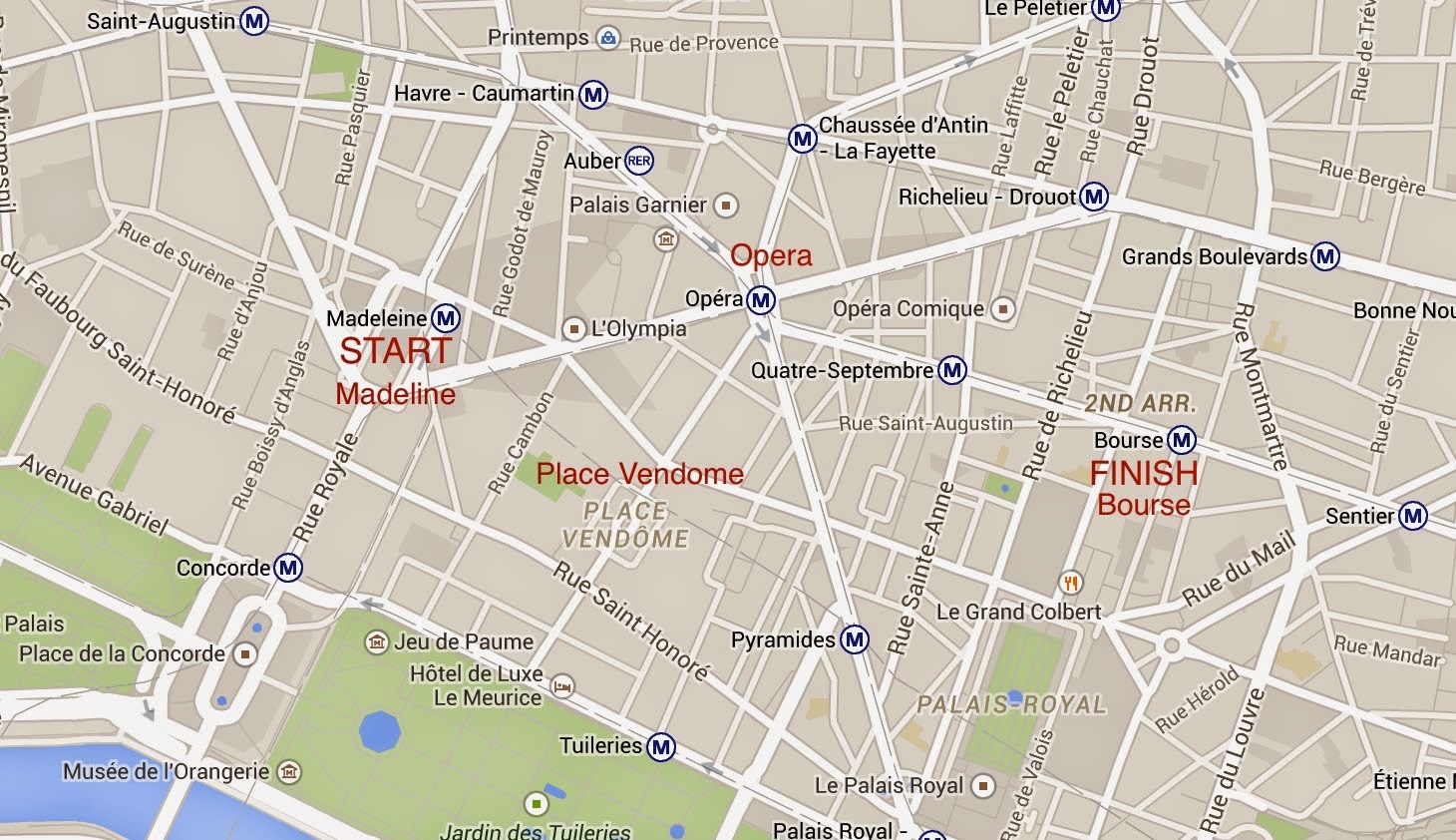
3) Madeleine - Place Vendôme - Opera - Bourse

Distance: 1.9km   Time: 20-30 mins     Time/Interest Rating: 2.7/3

Awesomest Moment: Watching the tourists go into the super expensive shops in Place Vendome, and then seeing them come out with bewildered looks on their faces: "$680 for a perfume??"


Brief Description: This is another awesome walk in central Paris. Start at the Place de Madeleine, where you'll see the BIG temple. (Of course, dedicated to the glory of Napoleon's army.)
The Place Vendôme Column from a distance...
watch out for cars!
It's startlingly similar to the Maison Carée in Nimes, only a lot larger. From there, you can walk down the Boulevard de la Madeleine, then the Rue des Capucines until you find the Place Vendôme. This is where some of the most expensive shops in Paris are. When you see a Chanel store and a Louis Vuitton store right next to each other, you know you're in an expensive shopping area. There's a big column right in the middle of the Place Vendôme, although it is currently under construction. From there, take
Rue de la Paix to the Opera, where you can marvel at the awesomeness of the Paris Opera House. (You can take a tour inside it, but I'll save that for a later blog post. After the Place de l'Opera, walk along the Rue du Quatre Septembre until you get to the Bourse Metro Station. The square is nothing special, but on Rue Vivienne (nearby) you'll notice a restaurant called Le Vaudeville. You MUST eat a meal here. It's expensive, but their smoked salmon is probably the best thing you have ever tasted. If you can't afford the (possibly) 40 euro per person cost, well... there's a Monoprix down the street *sighs*.


4) Notre Dame - Musee de Cluny - Sorbonne University - Luxembourg Gardens

Distance: 1.3km   Time: 15-25 mins    Time/Interest Rating: 2.2/3

Awesomest Moment: Just after the bridge that gets you off Ile de la Cité, you'll have the opportunity to go down the narrowest street in Paris...1.8m wide Rue de Chat Qui Pêche. It's located just off the Quai Saint-Michel.
Brief Description: If you want to see the Luxembourg Gardens and the Notre Dame Cathedral in one day, this is an excellent option if you don't want to take the Metro. (Note: If you want to do a more thorough exploration of the islands, I would not try to cram this walk into that day. Spend a whole
day exploring the islands, and tie this walk into an exploration of the area around the Luxembourg Gardens instead.) Starting at the Notre Dame Cathedral, walk across the Petit Pont, then follow the Rue du Petit Pont. It will eventually turn into the Rue Saint-Jaques, and three blocks past that point you will come across the Cluny Museum. It's full of Medieval art, located in a Gothic mansion. It's definitely not for everyone, and if you only have a few days in Paris, don't bother with it. If you're into Medieval stuff (which I'm not), you would probably find it interesting. After you pass the museum, you'll come across the Sorbonne Univeristy. Out of all the streets in this area,
In the depths of the Luxembourg Gardens, the Luxembourg Palace is...
well, not exactly hidden.
Rue des Écoles is the nicest. The others aren't spectacular or anything, but it gives you a taste of the Parisian lifestyle. As a general rule, stick to larger streets-- they are tree-covered, have large sidewalks, crosswalks, and are generally not sketchy. This is a pretty safe area, though, and you can explore any of the side streets, and... what are those trees over there? You've already arrived at the Luxembourg Gardens! These meticulously tended gardens are absolutely awesome, so enjoy a walk in the early afternoon or evening here.

I hope you enjoyed reading about these walks in Paris! If you find yourself in Paris, maybe you'll try out one of these walks. Walking to different attractions instead of taking the Metro is a great way to save money, get a taste of Parisian life, and have a good adventure!
(The most adventurous thing that can happen to you in the Metro is getting your jacket stuck in the turnstiles. Trust me, it happens...)


There's more!
Blog posts relating to these locations:
- Make the Most of Le Tour Eiffel (all about the Eiffel Tower and Champ de Mars)
- Islands on the Seine (Explains Île de la Cité, Notre Dame Cathedral, etc)
Soon to come...
- Gardens in Paris: Tuileries & Luxembourg
- The Paris Opera House